
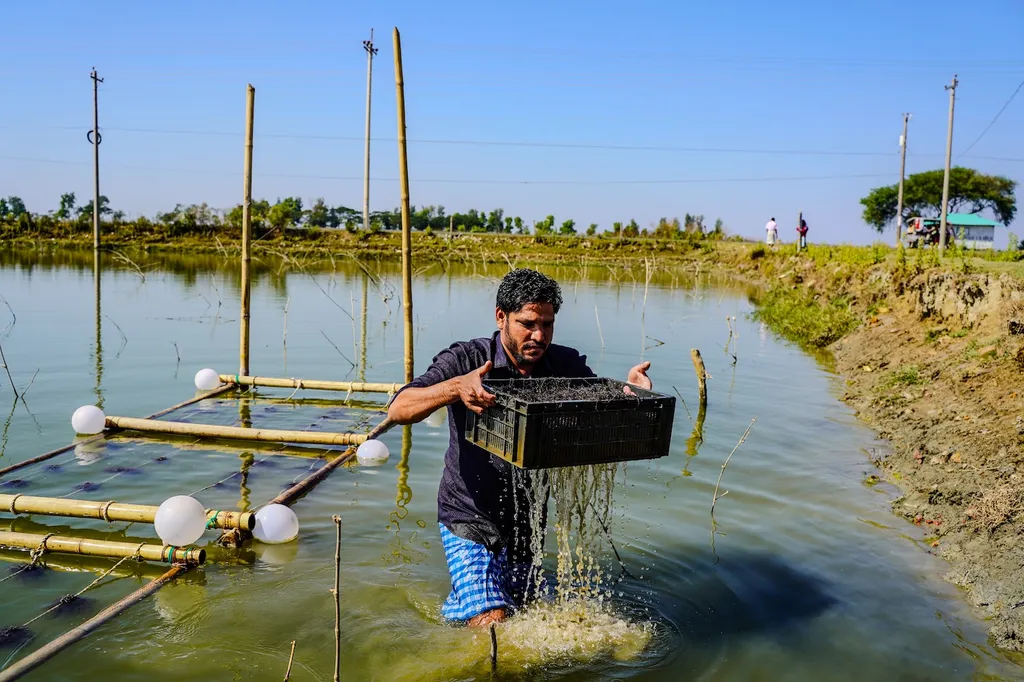
In the heart of Bangladesh, a quiet revolution is taking place, not in the bustling streets of Dhaka, but in the humble fish ponds that dot the countryside. Biofloc Technology, a sustainable aquaculture method, is transforming the regional economy, according to a recent study published in the journal *Samajik Unnayan O Suraksha* (Social Development & Security). The research, led by S.M. Naser Arafat from Gopalganj Science and Technology University, offers a compelling narrative of economic growth, job creation, and environmental sustainability.
Biofloc Technology, a system that promotes the growth of beneficial microorganisms in fish ponds, is proving to be a game-changer. Unlike traditional pond aquaculture, Biofloc systems recycle waste nitrogen into high-value microbial protein, significantly increasing production efficiency. “We found that Biofloc Technology not only reduces feed costs and space requirements but also enhances nitrogen utilization and improves economic returns,” Arafat explains.
The study, which employed a descriptive research design and secondary data analysis, compared traditional pond aquaculture with Biofloc-based systems. The results were striking. Biofloc Technology demonstrated higher survival rates, increased biomass output, and improved feed utilization. These findings suggest that the technology could be a boon for regions with limited land and water resources.
The economic implications are substantial. By promoting youth entrepreneurship and reducing unemployment, Biofloc Technology is contributing to a more resilient and sustainable aquaculture sector in Bangladesh. “This technology supports small-scale fish farming and aligns with circular-economy principles,” Arafat notes. “It’s a win-win for both the economy and the environment.”
The practical implications are equally compelling. Policy makers and stakeholders can leverage these findings to promote national strategies oriented toward food security and economic growth. The study strengthens theoretical perspectives on sustainable aquaculture and microbial-based nutrient recycling systems, paving the way for future developments in the field.
As the world grapples with the challenges of climate change and resource depletion, innovations like Biofloc Technology offer a glimmer of hope. By upcycling waste into valuable resources, this technology is not just transforming the aquaculture sector in Bangladesh—it’s reshaping our understanding of sustainable development. The research published in *Social Development & Security* (Samajik Unnayan O Suraksha) serves as a testament to the power of innovation in driving economic growth and environmental sustainability.