
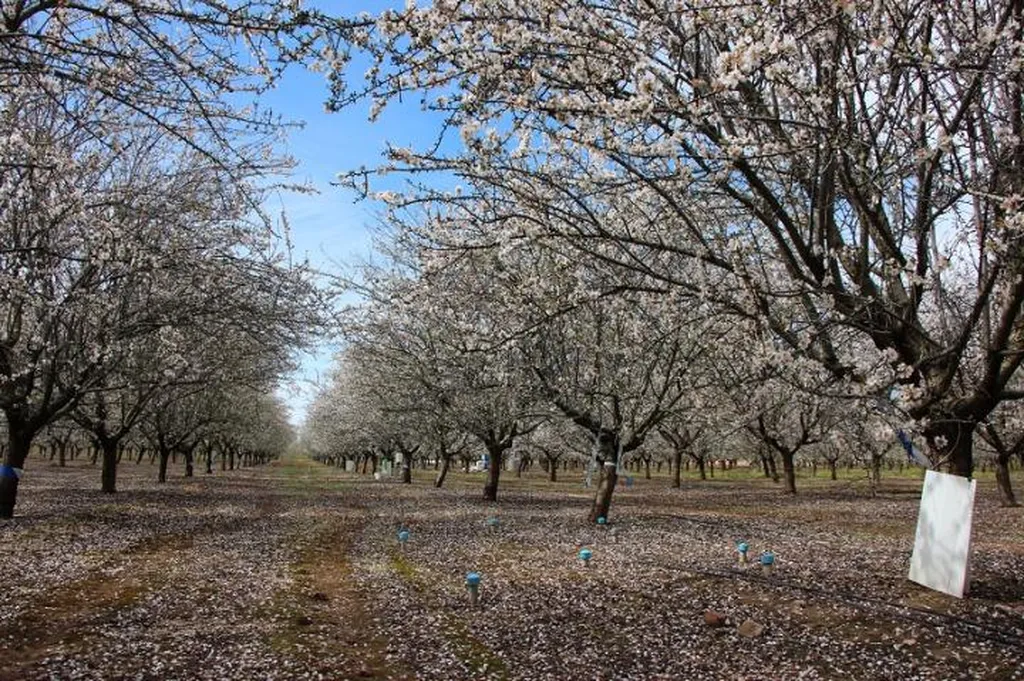
In the heart of Spain’s sun-scorched landscapes, a team of researchers led by Dr. S. Gutiérrez-Gordillo from the Plant Ecophysiology and Irrigation Group (ECOVER) at the Instituto de Recursos Naturales y Agrobiología (IRNAS) is unraveling the intricate dance between almond trees and water. Their work, published in the journal *Agricultural Water Management* (translated as *Water Management in Agriculture*), is shedding new light on how to optimize irrigation strategies for almond orchards, a critical industry in water-scarce regions.
Almonds, a staple crop in arid and semi-arid regions, have evolved to thrive in dry environments. Their deep roots and early phenology— the periodic biological phenomena such as flowering—give them a moderate tolerance to drought. However, when water stress becomes prolonged or severe, these adaptations fall short, leading to reduced yields. “Understanding the balance between tolerance and vulnerability is essential for developing irrigation strategies that ensure yield stability, nut quality, and long-term orchard resilience,” Gutiérrez-Gordillo explains.
The research delves into the anatomical and physiological responses of almond trees to water availability, highlighting key indicators like water potential, stomatal conductance, and leaf temperature. These indicators serve as tools to guide irrigation management, but their reliability hinges on environmental conditions, phenological stages, and cultivar-specific traits. This complexity makes defining universal thresholds a challenge.
Gutiérrez-Gordillo’s team emphasizes the importance of integrating anatomical and physiological evidence with recent advances in monitoring technologies. By doing so, they aim to support the development of standardized, adaptive irrigation protocols that enhance water use efficiency while preserving yield and nut quality. “Understanding cultivar adaptation and physiological thresholds is critical to ensure resilient almond production under increasing climate and water challenges,” Gutiérrez-Gordillo states.
The implications for the agricultural sector are profound. As water resources become increasingly scarce and climate conditions more unpredictable, the ability to optimize irrigation strategies is crucial. This research could pave the way for more efficient water use in almond orchards, ensuring that this valuable crop remains viable in the face of growing environmental pressures.
Moreover, the findings could have broader applications in the energy sector, particularly in regions where agriculture and energy production compete for limited water resources. By improving water use efficiency in agriculture, this research could help alleviate pressure on water supplies, benefiting both sectors.
The study’s focus on physiological indicators and their variability offers a nuanced approach to irrigation management. It underscores the need for tailored strategies that consider the unique characteristics of different almond cultivars and their specific environmental contexts. This tailored approach could lead to more sustainable and resilient agricultural practices, ultimately benefiting both farmers and consumers.
As the world grapples with the challenges of climate change and water scarcity, research like this provides a beacon of hope. By understanding the intricate relationship between almond trees and water, we can develop strategies that ensure the sustainability of this vital crop, securing its future in an increasingly water-limited world.