
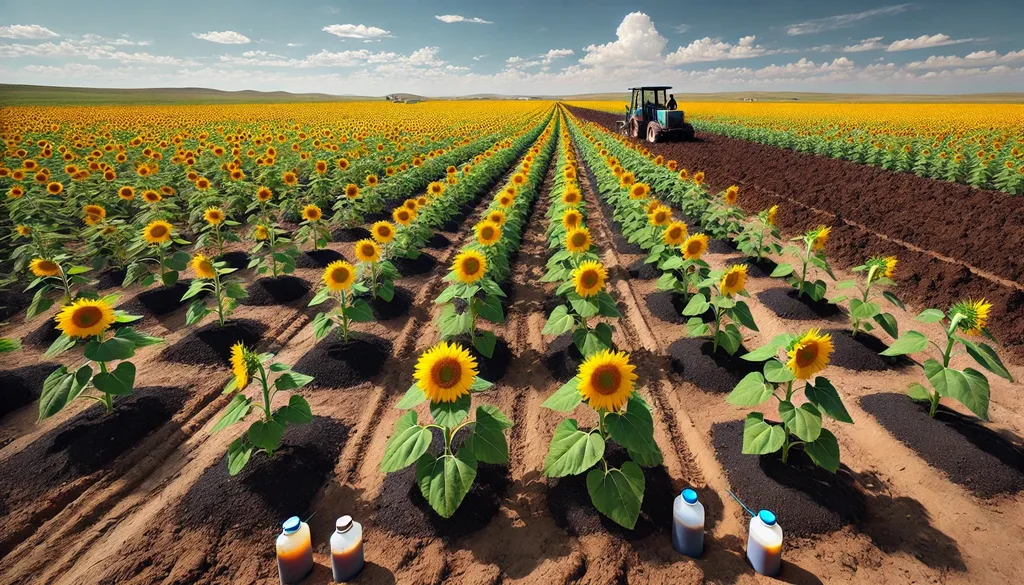
In the arid landscapes of sunflower farmlands, where water is a precious commodity and soil quality is a constant challenge, a new study offers a promising strategy to conserve freshwater resources and improve soil health. The research, led by Yibo Zhao from the College of Water Conservancy and Civil Engineer at Inner Mongolia Agricultural University, explores the synergistic effects of biochar and deficit irrigation on soil properties and organic carbon fractions. Published in the journal *Agricultural Water Management* (translated as “Agricultural Water Management”), the findings could have significant implications for the energy sector and sustainable agriculture.
Deficit irrigation, a practice where crops receive less water than they would under full irrigation, has long been recognized as a way to conserve water. Biochar, a carbon-rich product derived from the pyrolysis of organic materials, has gained attention for its potential to improve soil quality. However, the combined effects of these two strategies on the molecular composition of soil organic carbon (SOC) have remained insufficiently studied—until now.
Zhao and his team quantified the effects of three biochar rates (0, 15, and 30 tons per hectare) and two drip irrigation regimes—full (100% of evapotranspiration, ETc) and deficit (60% of ETc)—on various soil properties in sunflower soils. The results were striking. Under deficit irrigation, the application of 15 tons per hectare of biochar produced the greatest improvement in soil conditions. It raised soil moisture by 20.7% to 30.8%, water storage by 9.7% to 46.4%, total nitrogen by 5.6% to 16.1%, and SOC by 16.0% to 59.1%, while reducing bulk density by 1.2% to 14.6%.
“These findings suggest that a moderate application of biochar, combined with deficit irrigation, can significantly enhance soil health and water conservation,” Zhao explained. “This approach not only conserves freshwater resources but also improves the overall productivity of the soil.”
In contrast, the application of 30 tons per hectare of biochar primarily altered SOC fractions. It increased particulate organic carbon (POC) by 1.3% to 59.2%, caused an initial rise followed by a 11.1% to 35.9% decline in easily oxidizable carbon (EOC), and produced a short-term increase followed by a decrease in dissolved organic carbon (DOC). Under full irrigation, SOC and POC increased with biochar rates, with 30 tons per hectare achieving 21.2% to 95.1% and 53.4% to 62.8% higher levels, respectively, than no-biochar soils.
The study also employed random forest and structural equation modeling to identify the main drivers of these changes. Biochar rate was found to be the primary driver of POC, while soil chemical properties exerted stronger controls on EOC and DOC than physical properties.
“This research highlights the importance of understanding the complex interactions between biochar, irrigation practices, and soil properties,” Zhao noted. “By optimizing these factors, we can develop more sustainable and efficient agricultural practices.”
The implications of this research extend beyond the agricultural sector. In the energy sector, where water conservation and soil health are critical for sustainable operations, these findings could inform the development of new strategies to manage water resources and improve soil quality. As the world grapples with the challenges of climate change and water scarcity, the insights from this study offer a beacon of hope for a more sustainable future.
As Zhao and his team continue to explore the intricate relationships between biochar, irrigation, and soil health, the agricultural and energy sectors watch closely, eager to harness the potential of these innovative strategies. The journey towards sustainable agriculture and energy production is complex, but with each new discovery, the path becomes clearer and more promising.