
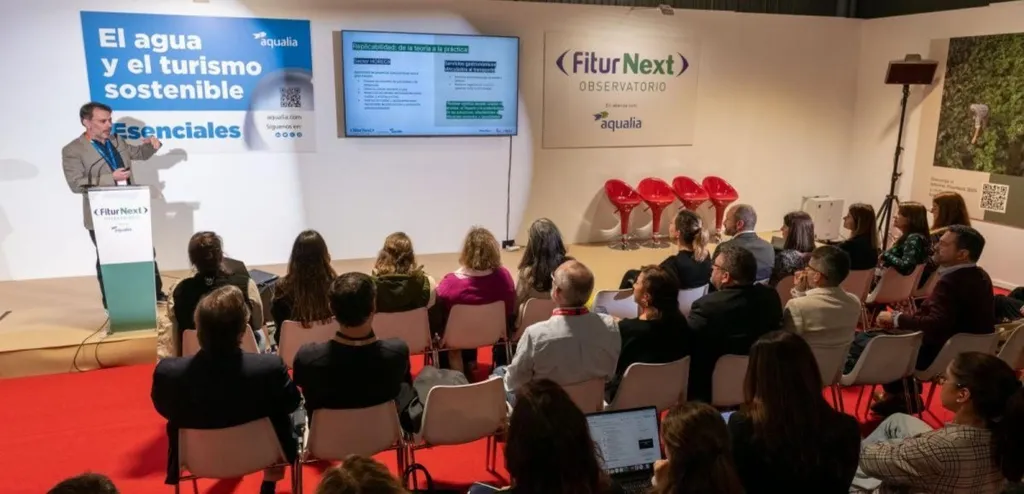
The seventh edition of FITURNEXT, FITUR’s Sustainability Observatory, has wrapped up, leaving a clear message: tourism must step up as a key player in sustainable water management. Supported by Aqualia, a leader in integrated water cycle management, the forum brought together over 40 experts from public and private sectors to share best practices and innovative solutions. The urgency is palpable—by 2030, global water demand is expected to outstrip supply, with half the world’s population facing high water stress. Tourism, as a water-dependent industry, must pivot from being part of the problem to driving solutions.
Lucas Díaz, Aqualia’s Country Director for Spain, set the tone during the opening session, emphasizing that the water footprint of a tourist can be up to six times greater than that of a resident. “Responsible water use cannot be merely an aspiration for tourism in our country; it must be understood as a standard for the sustainability and resilience of companies and destinations, as well as for their development and competitiveness,” he stated. This call to action underscores the need for tourism to adopt water efficiency not just as a goal, but as a non-negotiable benchmark for long-term viability.
The FITURNEXT 2026 Report, presented during the forum, analyzed nearly 300 global initiatives to identify pressures tourism places on water resources and highlight effective strategies for responsible management. Francisco Rodríguez, Head of the Tourism Area at Ideas for Change and Coordinator of the Observatory, outlined three critical pillars for action: public policies that incentivize sustainable management, leveraging technological advancements like robotization, IoT, and AI, and fostering collaboration among stakeholders—tourists, residents, companies, and public administrations. This multi-faceted approach reflects the complexity of the challenge and the necessity for systemic change.
The forum also recognized standout initiatives through the FITURNEXT 2026 Challenge. Fundación Visit València won in the Destinations and Other Territories category for its project to measure and certify the tourism water footprint, achieving a 95% water efficiency rate. Paula Llobet, Councillor for Tourism, Innovation and Investment Attraction at València City Council, emphasized the city’s commitment to a tourism model that balances innovation, resource efficiency, and quality of life for residents. Barceló Regen, part of the Barceló Group, was awarded in the HORECA and Transport Sector category for its efforts to reduce water consumption through technological upgrades and awareness campaigns like Songs 4 Showering. Belén Juárez Gómez, Head of Sustainability at the Group, highlighted the power of collective responsibility in driving meaningful change. Plastic Cup took home the prize in the Other Value Chain Stakeholders group for transforming river clean-ups into a collective tourism activity, removing over 400 tonnes of waste while promoting environmental education and regenerative tourism. Attila David Molnar, River Cleanup Expert at Plastic Cup, noted that good tourism goes beyond leaving footprints—it actively restores and improves the places we visit.
Beyond the awards, the forum featured round tables and talks that delved into water management as an urgent challenge for tourism. The municipality of Torrox (Málaga) showcased a successful public-private collaboration with Aqualia to improve water supply efficiency, demonstrating tangible benefits for local communities. Participants agreed that the sector must transition from isolated initiatives to integrated, long-term strategies that intertwine water, tourism, and sustainability.
This news signals a pivotal shift in the sector, where tourism is no longer seen as a passive consumer of water but as an active participant in its sustainable management. The emphasis on collaboration, innovation, and policy highlights the need for a holistic approach that engages all stakeholders. As the sector grapples with growing water scarcity, these discussions and initiatives could set a precedent for how tourism adapts to and mitigates its environmental impact. The challenge now is to translate these insights into widespread action, ensuring that tourism becomes a force for positive change in water management.