
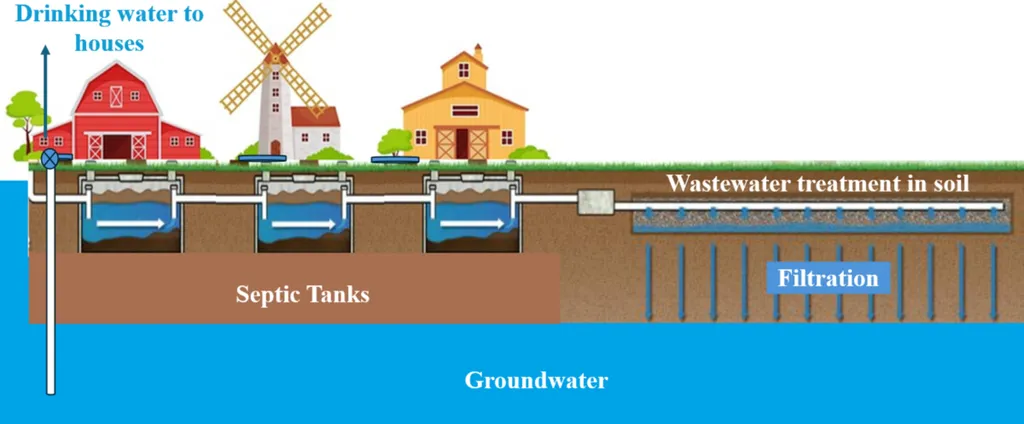
In the heart of Louisiana, researchers are tackling a pressing global challenge: how to bring the power of artificial intelligence (AI) to rural wastewater treatment systems. Jeimy Martinez De La Hoz, a researcher at the Department of Mechanical and Industrial Engineering at Louisiana State University, has published a comprehensive review in the journal *Applied Water Science* (translated from Spanish as *Applied Water Science*), highlighting the current state and future potential of AI in rural wastewater management.
The review, which spans literature from 2006 to 2024, reveals a stark contrast between urban and rural wastewater treatment systems. While AI has made significant strides in optimizing urban systems—reducing chemical usage, improving energy efficiency, and enhancing operational effectiveness—rural systems lag behind. “Rural areas face unique challenges such as data scarcity, incompatible infrastructure, and limited interpretability of AI models,” Martinez De La Hoz explains. These challenges not only hinder the effectiveness of wastewater treatment but also exacerbate environmental pollution and public health risks in rural communities.
The commercial implications for the energy sector are substantial. Efficient wastewater treatment systems can lead to significant energy savings, a critical factor as the world grapples with climate change and the need for sustainable energy solutions. AI-driven systems can optimize energy consumption in wastewater treatment plants, reducing operational costs and carbon footprints. “By addressing these gaps, we can unlock the potential of AI to create more sustainable and cost-effective wastewater treatment solutions,” Martinez De La Hoz says.
The review identifies several key barriers to AI adoption in rural areas, including the lack of real-time monitoring and the need for more interpretable AI models. To bridge these gaps, Martinez De La Hoz proposes a modular, interpretable AI framework that incorporates hierarchical input decomposition, adaptive data augmentation, and real-time monitoring strategies tailored to rural conditions. This approach could revolutionize rural wastewater management, making it more reliable, affordable, and sustainable.
The research also points to future directions, such as energy-efficient, cost-effective, and privacy-preserving federated learning methodologies. These advancements could pave the way for scalable AI interventions that mitigate environmental risks, safeguard public health, and promote sustainable wastewater infrastructure in rural communities.
As the world continues to grapple with the challenges of climate change and resource scarcity, the need for innovative solutions in wastewater management has never been greater. Martinez De La Hoz’s research offers a glimpse into a future where AI plays a pivotal role in creating more sustainable and resilient communities. “The potential is there,” she says. “We just need to overcome the barriers and make it happen.”
This research not only highlights the current state of AI in wastewater management but also provides a roadmap for future developments. By addressing the unique challenges faced by rural communities, we can create more effective and sustainable solutions that benefit both the environment and the energy sector. As Martinez De La Hoz’s work shows, the future of wastewater management lies in the intersection of technology, innovation, and community engagement.