
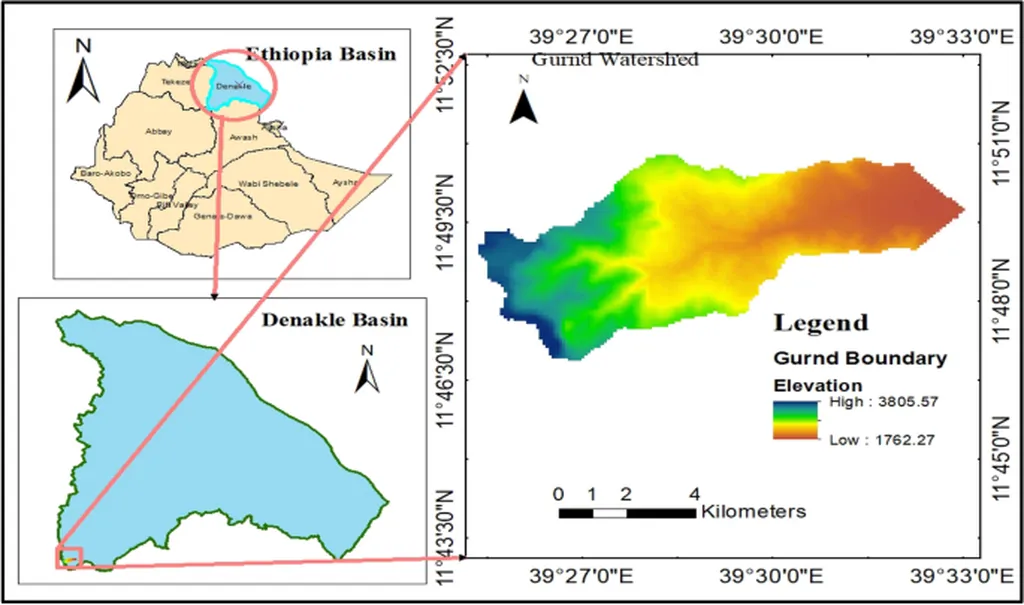
In the arid expanses of Northeastern Ethiopia, where water scarcity has long been a formidable adversary, a beacon of hope emerges from the intersection of technology and sustainability. Researchers, led by Anwar Assefa Adem from the Department of Natural Resources Management at Bahir Dar University, have harnessed the power of geospatial tools to map the potential for water harvesting in the moisture-stressed North Wollo Zone. Their findings, published in the journal ‘Applied Water Science’ (translated to ‘Applied Water Science’), offer a promising path forward for communities grappling with drought, crop failures, and food insecurity.
The study employed a sophisticated blend of geospatial techniques, including the Analytical Hierarchical Process (AHP) and weighted overlay analysis, to evaluate various factors crucial for water harvesting. These factors ranged from topographic features like slope to hydrological aspects such as rainfall, drainage density, and runoff, as well as soil characteristics, land use, and socioeconomic considerations like proximity to roads.
“By integrating these diverse parameters, we aimed to provide a comprehensive assessment of the suitability of different areas for water harvesting practices,” Adem explained. The results were revealing: less than 1% of the study area was deemed highly suitable, while 39.3% was classified as moderately suitable. These moderately suitable areas, covering 4,802.6 km², present significant opportunities for installing water harvesting structures that could greatly benefit local communities.
The research also shed light on the adaptive strategies of the local population. Verification of existing water harvesting structures showed that 74% were located in moderately suitable areas, while the remaining 26% were in marginally suitable areas. This indicates that communities are already making the best use of the land available to them, despite the challenges.
The implications of this research extend beyond the immediate region. By demonstrating the effectiveness of geospatial and multicriteria approaches in sustainable water resource planning, the study sets a precedent for similar initiatives in other drought-prone areas. The integration of geospatial tools with local knowledge can pave the way for more resilient and adaptive water management strategies.
For the energy sector, the potential commercial impacts are substantial. Water harvesting can support agricultural activities, which in turn can drive demand for energy solutions tailored to rural and agricultural settings. This includes solar-powered irrigation systems, energy-efficient water pumps, and other innovative technologies that can thrive in water-scarce environments.
Adem’s work underscores the importance of interdisciplinary approaches in addressing complex environmental challenges. “Future studies should incorporate additional socioeconomic parameters and higher-resolution datasets to refine the identification of suitable water harvesting sites,” he suggested. This will not only enhance the accuracy of site selection but also support evidence-based watershed management strategies.
As the world grapples with the escalating impacts of climate change, the insights from this research offer a glimmer of hope. By leveraging technology and community knowledge, it is possible to transform arid landscapes into sustainable and productive areas. The journey towards water security in Northeastern Ethiopia is just beginning, but with each step, the path becomes clearer and more promising.