
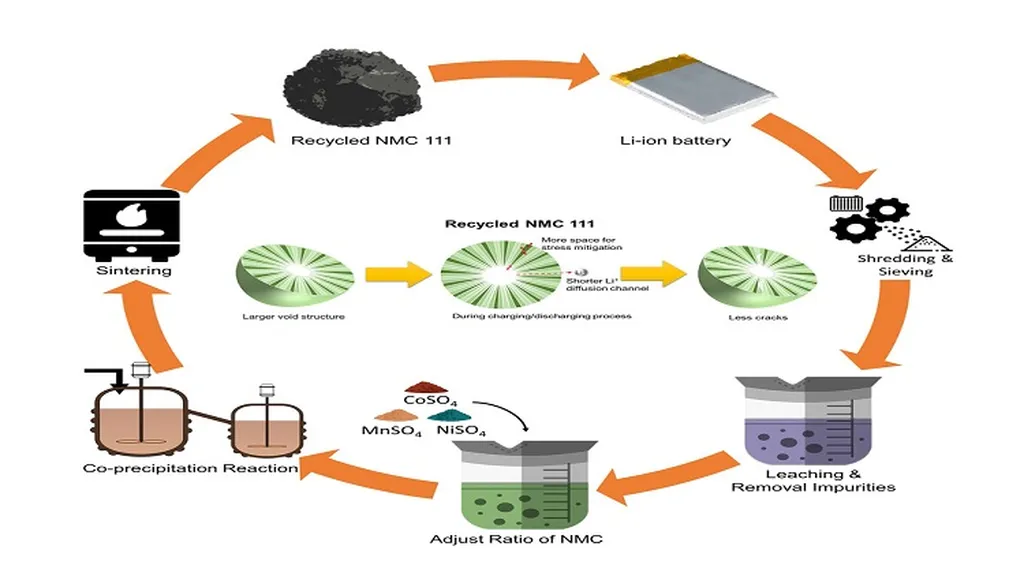
In a significant stride towards a more sustainable and efficient battery supply chain, researchers have developed a novel recycling process that not only recovers critical materials from spent lithium-ion batteries but also upgrades their quality. Published in *Cell Reports Sustainability* (translated from Chinese as “Cell Reports Sustainability”), this study introduces a polyol-metallurgical approach that transforms polycrystalline cathodes into single-crystal cathodes, enhancing their performance and reducing waste.
The lead author, Lu Yu, from the Electrification and Energy Infrastructures Division at Oak Ridge National Laboratory, explains, “Our method leverages the unique properties of citric acid and ethylene glycol to simplify the recycling process. By controlling the coprecipitation phase, we can precisely manipulate the morphology and particle sizes of the recycled materials.”
The conventional recycling methods for lithium-ion batteries are often complex, water-intensive, and prone to introducing impurities, which can compromise the quality of the resynthesized cathode materials. The new polyol-metallurgical process addresses these challenges by using a citric acid-ethylene glycol solution for both leaching and coprecipitation. This dual-function approach eliminates the need for complicated separation processes and ensures the purity of the recycled materials.
One of the most compelling aspects of this research is the ability to upgrade polycrystalline cathodes to single-crystal cathodes. The resulting LiNi0.6Co0.2Mn0.2O2 (NMC622) cathode exhibits a single-crystal morphology with grain sizes around 10 μm, free of impurities and with a composition similar to the pristine cathode. This upgrade not only enhances the electrochemical performance but also opens new avenues for producing advanced cathode materials from waste streams.
The implications of this research extend beyond recycling, offering a pathway to a circular economy in battery production. By recovering and reusing critical materials such as nickel, cobalt, and manganese, the method addresses both sustainability and performance challenges. “This innovation provides the industry and society with a cleaner, more efficient solution for recovering and reusing battery materials,” Yu adds.
The commercial impacts for the energy sector are substantial. As the demand for electric vehicles, portable devices, and renewable energy storage continues to grow, the need for efficient and sustainable battery recycling becomes increasingly critical. This new recycling process could significantly reduce the environmental footprint of battery production and disposal, while also conserving valuable resources.
Looking ahead, this research sets the stage for future developments in battery recycling and synthesis. The ability to control particle morphology and achieve single-crystal structures could lead to the development of even more advanced cathode materials with superior performance. As the industry continues to evolve, this innovative approach could play a pivotal role in shaping a more sustainable and efficient energy future.
In summary, this groundbreaking study published in *Cell Reports Sustainability* demonstrates the potential of polyol metallurgy as a novel and efficient method for recycling lithium-ion batteries and synthesizing advanced cathode materials. By addressing the challenges of conventional recycling methods and upgrading the quality of recycled materials, this research offers a promising solution for the energy sector and a step towards a more sustainable future.