
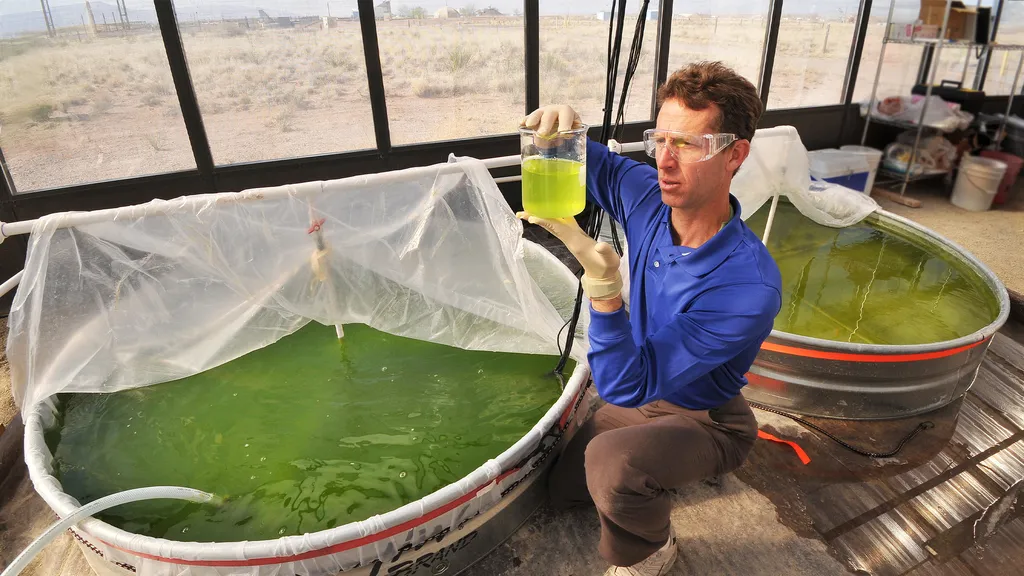
In a world grappling with the dual challenges of climate change and energy security, algae-based biofuels have emerged as a promising contender in the renewable energy landscape. A recent study published in the journal *Water Resources Research* sheds light on the water and land implications of this burgeoning industry, offering valuable insights for the energy sector.
The research, led by P. W. Gerbens-Leenes of the University of Twente’s Twente Water Centre in the Netherlands, assesses the blue water footprint and land use of algae-based biofuels. The study combines the water footprint concept with an energy balance approach to determine the blue water footprint of net energy, considering both open ponds and closed photobioreactors (PBRs).
The findings reveal that all systems have a positive energy balance, with output-input ratios ranging between 1.13 and 1.98. However, the water footprint of algae-based biofuels varies significantly, lying between 8 and 193 cubic meters per gigajoule (GJ) of net energy provided. This variability underscores the importance of understanding the specific conditions and technologies used in algae cultivation.
“Algae-based biofuels have the potential to play a significant role in the future energy mix,” Gerbens-Leenes said. “However, our study shows that a transition to these biofuels will substantially increase competition over water and land resources.”
The study also highlights the land use requirements of microalgal biofuels, which range from 20 to 200 square meters per GJ of net energy. For a scenario where algae-based biofuels provide 3.5% of the transportation fuels in the European Union in 2030, the system with the highest land productivity would need 17,000 square kilometers to produce the required 850 petajoules per year.
Producing all algae-based biofuels through the system with the highest water productivity would lead to a blue water footprint of 7 cubic kilometers per year, equivalent to 15% of the present blue water footprint in the EU28. These findings underscore the need for careful planning and resource management as the energy sector explores algae-based biofuels.
The research published in *Water Resources Research* (which translates to *Water Resources Research* in English) offers a critical perspective on the commercial impacts of algae-based biofuels. As the energy sector seeks to diversify its portfolio and reduce greenhouse gas emissions, understanding the water and land implications of new technologies becomes increasingly important.
This study serves as a reminder that the transition to renewable energy is not without its challenges. It calls for a balanced approach that considers not only the energy potential of new technologies but also their environmental and resource implications. As the world moves towards a more sustainable energy future, research like this will be instrumental in shaping policies and practices that ensure a just and equitable transition for all.