
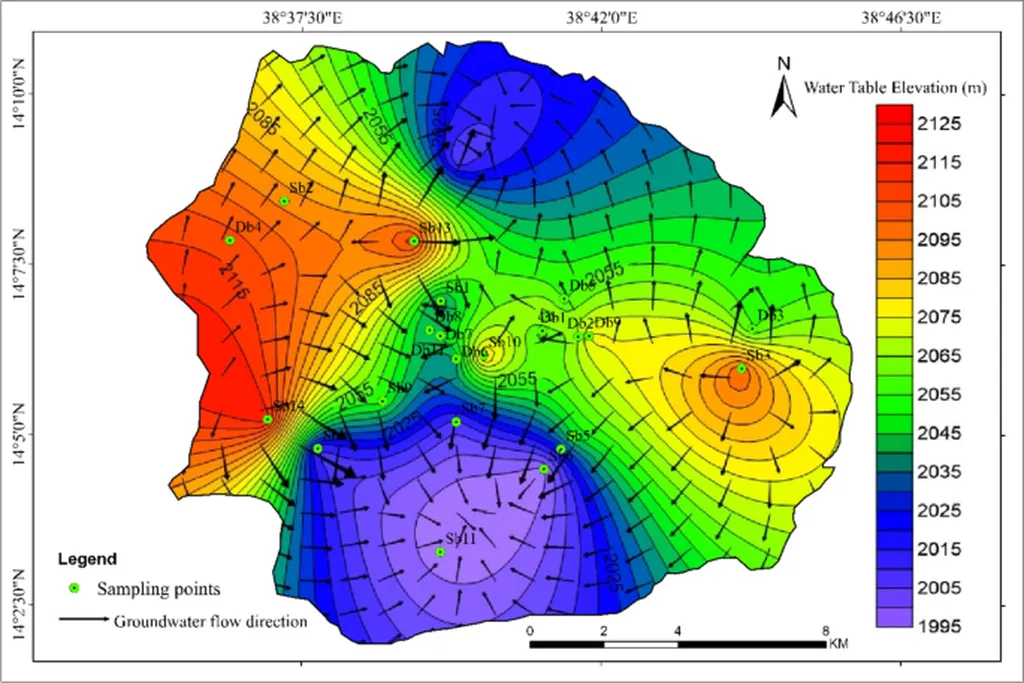
In the heart of Southern Ethiopia, a critical resource is under scrutiny: groundwater. As population growth and agricultural expansion place increasing demands on this vital resource, understanding its quality and suitability for drinking and irrigation becomes paramount. A recent study led by Yonas Oyda from the Department of Geology at Arba Minch University has shed light on the groundwater quality in the Maze Zenti catchment, offering insights that could shape future water management strategies and have significant commercial impacts for the energy sector.
The study, published in the journal *Geosciences* (translated from the original German title), employed an integrated approach to evaluate groundwater suitability. By analyzing 30 samples, Oyda and his team utilized a combination of methods, including GIS-based IDW interpolation, hydrochemical characterization, and various statistical and graphical tools. Their goal was to assess the groundwater’s fitness for both drinking and irrigation purposes.
One of the key findings was the strong association between sodium (Na+) and total dissolved solids (TDS), as well as sodium and calcium (Ca2+). “This indicates that mineral dissolution, ion exchange, and agricultural inputs are key factors influencing groundwater quality in the region,” Oyda explained. The study also revealed weak correlations for nitrate (NO3−) and fluoride (F−), suggesting localized anthropogenic and geogenic influences.
The hydrochemical facies were primarily identified as calcium-magnesium-bicarbonate (Ca-Mg-HCO3) with some localized sodium-bicarbonate (Na-HCO3) types. This suggests that rock-water interactions are the primary source of geochemical control in the area. “This is crucial for understanding the natural processes that affect groundwater quality,” Oyda noted.
The drinking water quality assessment showed that during the wet season, 52.8% of the catchment had excellent water quality, 45.8% was good, and 1.4% was poor–very poor. In the dry season, the numbers were slightly different: 51.6% excellent, 47.4% good, 0.8% poor, and 0.2% very poor. The entropy-weighted analysis indicated a seasonal improvement, with excellent areas increasing from 13.1% to 31.4% and poor zones decreasing from 7.5% to 3.4%.
For irrigation, the study found low sodicity and salinity hazards, suggesting that the groundwater is generally suitable for agricultural use. This is a significant finding for the energy sector, as agriculture is a major consumer of water resources. Understanding the quality and suitability of groundwater for irrigation can help in planning and managing water resources more effectively, ensuring sustainable agricultural practices and energy production.
The study also provides the first integrated seasonal mapping of drinking and irrigation water quality, entropy-weighted water quality, and pollution index for the Maze Zenti catchment. This establishes a hydrogeochemical baseline that can guide future research and water management strategies.
As Oyda and his team continue to explore the complexities of groundwater quality, their work underscores the importance of integrated approaches in understanding and managing this vital resource. For the energy sector, this research offers valuable insights that can inform decision-making and promote sustainable practices. The findings published in *Geosciences* not only highlight the current state of groundwater quality in the Maze Zenti catchment but also pave the way for future developments in the field.