
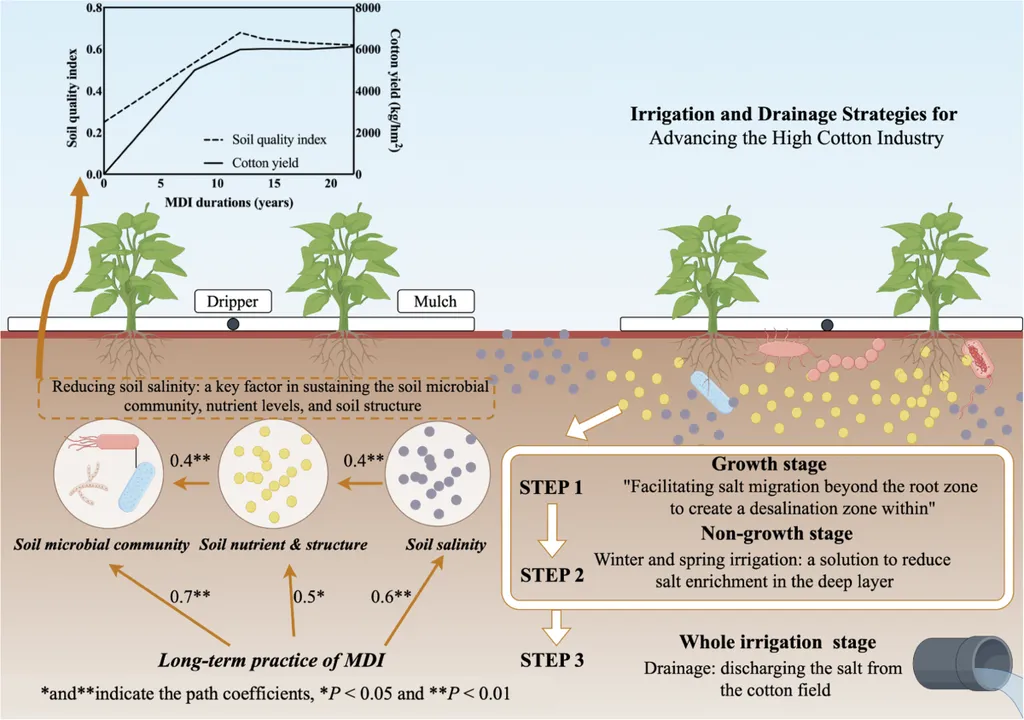
In the arid expanses of Xinjiang, China, a groundbreaking study led by Jiangtao Wang from the Key Laboratory of Oasis Eco-agriculture at Shihezi University and the Henan Dryland Agricultural Engineering Technology Research Center has unveiled a promising approach to boost cotton water productivity. The research, published in the journal ‘Agricultural Water Management’ (translated as ‘Irrigation and Drainage Management’), focuses on mulched drip irrigation (MDI), a water-saving technology that combines surface plastic film mulching with drip irrigation.
Cotton production in arid regions has long been challenged by water scarcity and inefficient irrigation methods. Traditional flood irrigation (TFI) often leads to water wastage and uneven distribution, impacting cotton yield and water productivity. Wang’s study aimed to quantify the benefits of MDI in stabilizing shallow soil water supply, enhancing leaf photosynthesis, and ultimately improving water productivity.
The two-year field experiment compared MDI and TFI at two different irrigation volumes: 390 mm and 600 mm. The results were striking. MDI maintained stable soil water content in the top 40 cm of soil and increased it by 4.80–12.87% in the top 60 cm during critical flowering and boll stages. This stability enhanced leaf relative water content and chlorophyll content, boosting the average photosynthetic rate by 5.95–12.04%.
“Mulched drip irrigation not only stabilizes shallow soil water but also significantly enhances leaf physiology and photosynthesis,” Wang explained. “This dual effect is crucial for improving cotton water productivity in arid regions.”
The study found that the optimal irrigation volume for MDI was 390 mm, achieving the highest water productivity by reducing total water use by 8.14–15.46% compared to TFI while maximizing yield. Increasing the irrigation volume to 600 mm led to excessive vegetative growth and reduced water productivity, highlighting the importance of optimizing irrigation amounts.
The research also quantified the relative contributions of agronomic and engineering water savings. Reducing the irrigation volume contributed 57.44% of the water saving, while shifting to mulched drip irrigation contributed 42.56%. This finding underscores the importance of adopting efficient irrigation methods to fully realize water-saving potential.
The implications for the agricultural and energy sectors are significant. As water resources become increasingly scarce, the need for efficient irrigation technologies grows. MDI offers a sustainable solution that can enhance cotton yield and water productivity, ultimately benefiting farmers and the broader economy.
“This study demonstrates that in arid regions, maximizing water productivity requires first optimizing the irrigation amount, and then adopting efficient irrigation methods to fully realize this potential,” Wang noted.
The findings of this research could shape future developments in the field of agricultural water management. By integrating advanced irrigation technologies with optimized water use strategies, farmers can achieve higher yields with lower water inputs, contributing to sustainable agriculture and food security.
As the global population continues to grow, the demand for water-efficient agricultural practices will only increase. The insights from Wang’s study provide a valuable roadmap for achieving these goals, offering hope for a more sustainable and productive future in cotton production and beyond.