
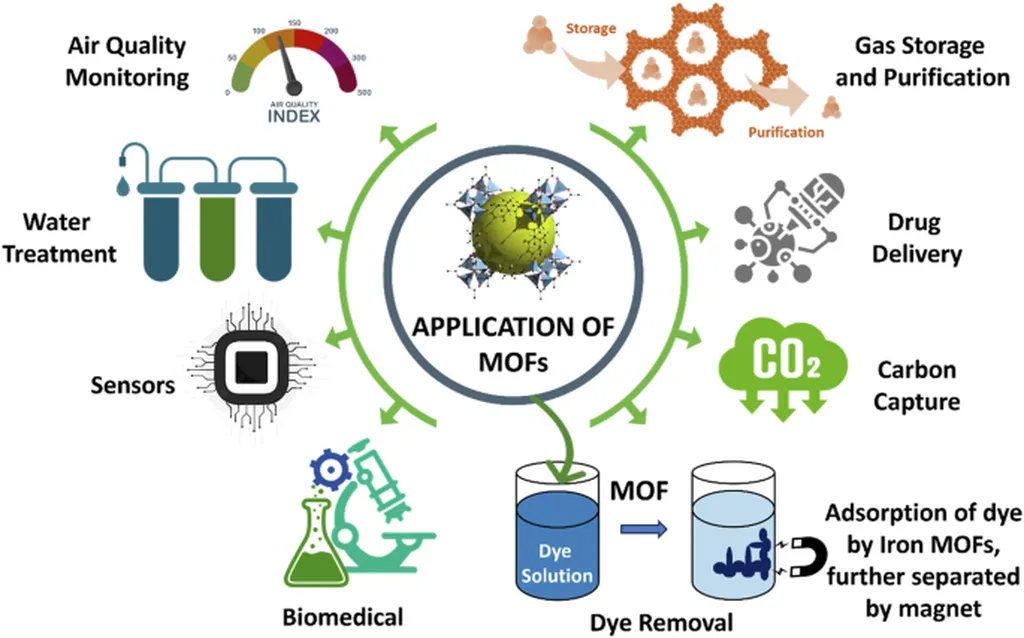
In the quest for cleaner water, scientists are turning to innovative materials that could revolutionize wastewater treatment. A recent study published in *JPhys Materials* (Chinese: *物质科学与工程*) offers a comprehensive look at how Fe3O4 magnetic nanoparticles combined with metal-organic frameworks (MOFs) and their derivatives could be game-changers in this field. Led by Xin Liang from the School of Materials Science and Engineering at Shenyang University of Technology in China, the research delves into the synthesis, modification, and application of these materials, providing a roadmap for future advancements.
The study highlights the urgent need for effective wastewater treatment solutions, driven by global population growth, industrialization, and climate change. “Despite progress, there’s a significant gap in understanding how to optimize these materials for real-world applications,” says Liang. The research addresses this by exploring various synthesis techniques, including solvothermal methods, as-grown methods, co-precipitation methods, and layer-by-layer self-assembly. These techniques are crucial for tailoring the properties of Fe3O4-based MOFs to enhance their performance in wastewater treatment.
One of the key aspects of the study is the exploration of surface functionalization strategies. By incorporating metal ion doping, composite with carbon materials, metal oxide/sulfide composites, non-metallic composites, biopolymer composites, and layered double hydroxides, the researchers aim to improve the material properties and efficiency of these frameworks. “Surface functionalization is a critical step in enhancing the adsorption capacity and selectivity of these materials,” explains Liang. This could lead to more efficient removal of pollutants such as antibiotics, pesticides, heavy metals, and organic dyes from wastewater.
The commercial implications for the energy sector are substantial. Efficient wastewater treatment is not only essential for environmental sustainability but also for the energy industry, which often relies on large volumes of water for various processes. By developing advanced materials that can effectively treat wastewater, the energy sector can reduce its environmental footprint and comply with increasingly stringent regulations. This could open up new opportunities for innovation and investment in sustainable technologies.
Looking ahead, the research predicts future challenges and developments in this field. “While the potential is immense, there are still hurdles to overcome, such as scaling up production and ensuring cost-effectiveness,” says Liang. However, the study lays a solid foundation for future research, offering new pathways for more efficient and sustainable water purification technologies.
As the world grapples with water resource security, the insights from this study could shape the future of wastewater treatment. By providing a detailed examination of Fe3O4-based MOFs and their derivatives, the research not only fills a critical gap in the literature but also paves the way for advancements that could have far-reaching impacts on both the environment and the energy sector.