
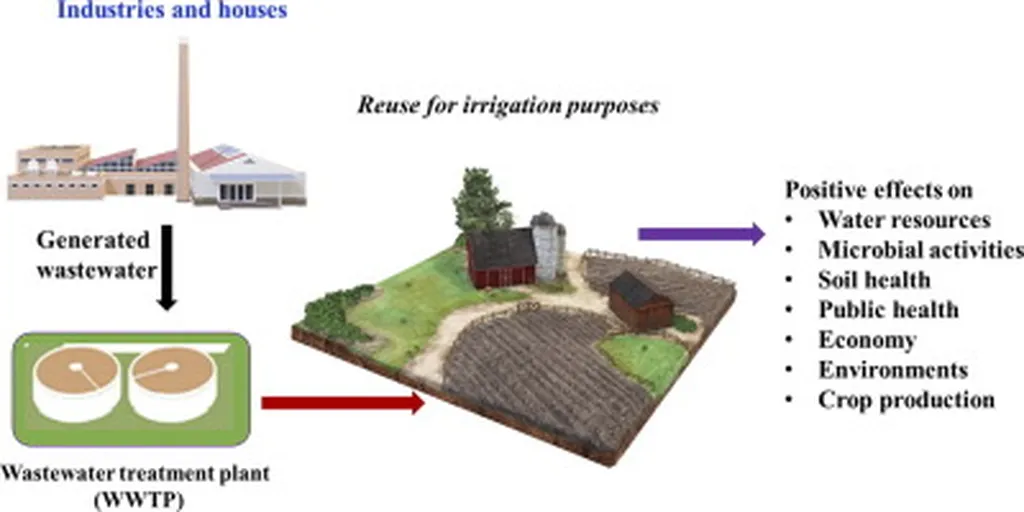
In a world grappling with water scarcity and climate change, the age-old practice of wastewater reuse for irrigation is gaining new momentum, and a recent study published in *Next Sustainability* (which translates to *Next Sustainability*) is shedding light on the global evolution of this critical practice. Led by Erewari Ukoha-Onuoha from the Department of Agricultural and Environmental Engineering at Rivers State University in Nigeria, the research offers a comprehensive look at the benefits, challenges, and future directions of wastewater reuse in agriculture, with implications that extend to the energy sector and beyond.
Wastewater reuse in agriculture is not a new concept, but its implementation varies widely across the globe, with differing outcomes. Ukoha-Onuoha’s study synthesizes findings from around the world, revealing a complex landscape where the benefits are substantial but the challenges are significant. “The reuse of wastewater in agriculture offers a promising solution to water scarcity and food security,” Ukoha-Onuoha explains. “It reduces the demand for freshwater, recovers valuable nutrients, and can even increase agricultural yields. However, it’s not without its risks and challenges.”
The benefits of wastewater reuse are clear. By reusing wastewater, farmers can reduce their reliance on freshwater sources, which is particularly important in water-scarce regions. Additionally, wastewater often contains nutrients that can enhance soil fertility and boost crop yields. This practice also aligns with the principles of the circular economy, where waste is minimized, and resources are kept in use for as long as possible. “The circular economy aspect is crucial,” Ukoha-Onuoha notes. “It’s about closing the loop and ensuring that resources are used efficiently and sustainably.”
However, the challenges are equally significant. Public health risks, soil salinization, and the presence of contaminants are major concerns. High costs, regulatory issues, and social acceptance also pose barriers to widespread adoption. The study highlights that water stress, economic capacity, and institutional strength significantly affect the sustainability of reuse systems. “In sub-Saharan Africa, for instance, informal and poorly regulated wastewater reuse is prevalent,” Ukoha-Onuoha points out. “This underscores the need for integrated management, suitable technologies, and unified policy frameworks.”
For the energy sector, the implications are profound. Water and energy are intrinsically linked, and the reuse of wastewater can reduce the energy required for water treatment and transportation. This can lead to significant cost savings and a reduced carbon footprint. Moreover, the recovery of nutrients from wastewater can be integrated into energy production processes, further enhancing sustainability.
The study also emphasizes the need for digital monitoring and advanced technologies to ensure the safe and efficient reuse of wastewater. This is where the energy sector can play a pivotal role. Investing in innovative technologies and digital infrastructure can not only improve the sustainability of wastewater reuse but also create new commercial opportunities.
As the world continues to grapple with water scarcity and climate change, the findings of this study offer valuable insights and guidance. “The future of wastewater reuse lies in integrated management, suitable technologies, and unified policy frameworks,” Ukoha-Onuoha concludes. “By addressing the challenges and leveraging the benefits, we can enhance the sustainability of wastewater reuse for irrigation and contribute to a more resilient and sustainable future.”
Published in *Next Sustainability*, this research is a call to action for policymakers, farmers, and industry leaders to collaborate and drive forward the sustainable reuse of wastewater in agriculture. The energy sector, in particular, has a unique opportunity to lead the way in this transformative journey, shaping a future where water and energy are used efficiently and sustainably.