
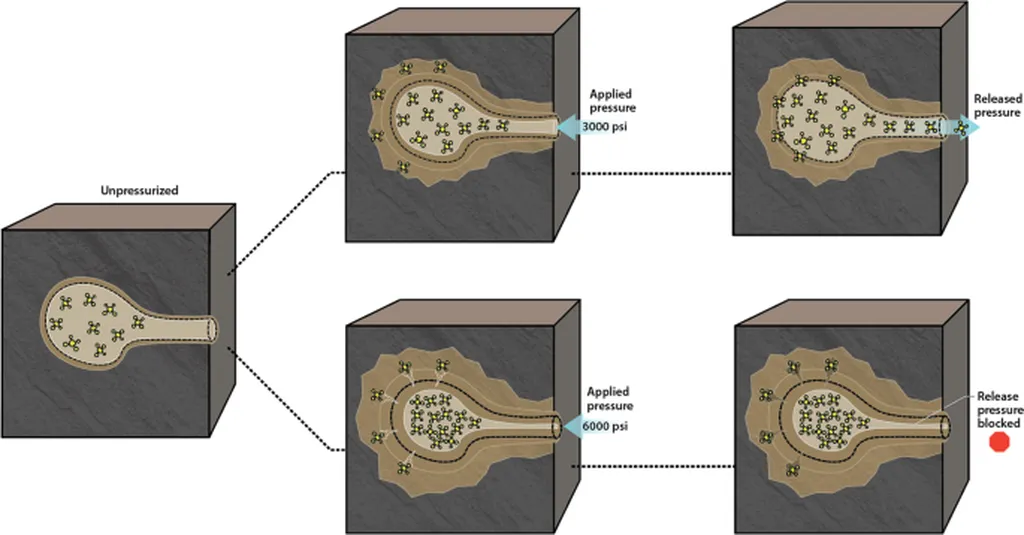
In the quest to mitigate greenhouse gas emissions and optimize carbon capture and storage (CCS) technologies, a groundbreaking study has shed light on the intricate behavior of methane (CH4) and carbon dioxide (CO2) in shale nanopores under varying water-bearing and saline conditions. This research, led by Kai Du from the State Key Laboratory of Petroleum Resources and Engineering at the China University of Petroleum (Beijing), could significantly impact the energy sector’s approach to unconventional oil and gas extraction and CO2 storage.
The study, published in *Meitian dizhi yu kantan* (translated as *Modern Geoscience and Kantian*), employed molecular dynamics simulations to construct slit-shaped nanopore models of montmorillonite, a common clay mineral in shale formations. By systematically analyzing the adsorption configurations, density distributions, diffusion behavior, and interaction energy variations of CH4 and CO2 under different conditions, the researchers uncovered critical insights into the competitive behavior and distribution patterns of these gases.
In dry systems, CO2 formed distinct adsorption layers along the montmorillonite surfaces, while CH4 exhibited a bimodal density distribution with a peak reaching up to 1.78 g/cm³. However, the introduction of water altered this dynamic. “After water was added to the dry system, water layers covered the montmorillonite surfaces, weakening gas-mineral interactions,” explained Du. “Consequently, CO2 and CH4 migrated toward the nanopore center.”
The addition of NaCl further complicated the scenario. CO2 formed secondary adsorption layers at the interfaces, with the peak density of adsorbed CO2 under a NaCl mass fraction of 20% recovering to about 17% of the peak value in the dry system. “With an increase in salinity, both CO2 and CH4 displayed decreased self-diffusion coefficients, especially CO2, suggesting that CO2 diffusion was more significantly restricted,” Du noted.
The study revealed that while water films weakened the adsorption potential on the montmorillonite surfaces, Na+ enhanced the interfacial re-adsorption of CO2 through electrostatic shielding and hydration clustering. This molecular-scale understanding of CO2 retention in water-bearing and saline environments is pivotal for optimizing CO2 storage and flooding processes in the energy sector.
The implications of this research are far-reaching. For the energy sector, understanding the behavior of CO2 and CH4 in shale nanopores under different conditions can enhance the efficiency and safety of CO2 storage, a critical component of CCS technologies. It can also improve the extraction processes of unconventional oil and gas, which are increasingly important as traditional resources deplete.
As the world moves towards peak carbon dioxide emissions and carbon neutrality, this study provides a crucial scientific foundation for the optimization of CO2 storage and flooding processes. By revealing the molecular-scale mechanisms of gas behavior in shale nanopores, it paves the way for more effective and efficient energy extraction and storage strategies, ultimately contributing to a more sustainable energy future.