
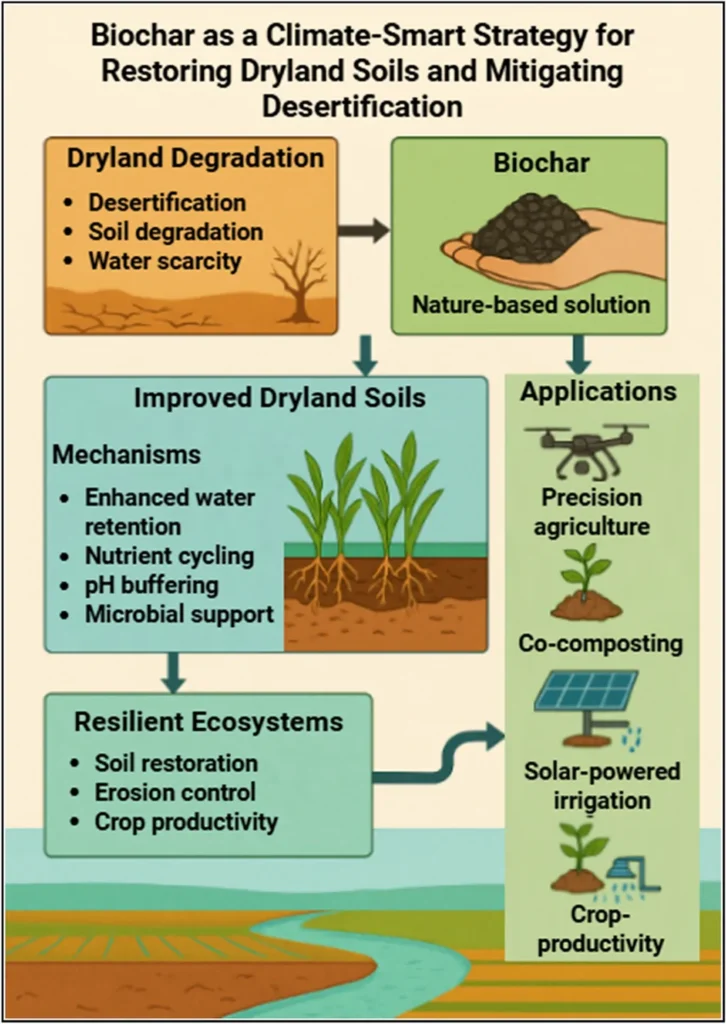
In the face of escalating climate change, dryland regions are grappling with severe soil degradation and desertification, threatening food security and ecosystem stability. A groundbreaking review published in the journal *Biochar* (translated from Chinese as “生物炭”) offers a promising solution: biochar, a carbon-rich product derived from organic waste, could be a game-changer for restoring degraded soils and mitigating desertification. The research, led by Abdul Waheed from the State Key Laboratory of Desert and Oasis at the Xinjiang Institute of Ecology and Geography, Chinese Academy of Sciences, explores biochar’s potential as a climate-smart strategy for sustainable land management.
Biochar’s unique physicochemical properties make it an effective soil amendment. It improves soil structure, boosts water retention, enhances nutrient cycling, and supports microbial communities. “Biochar acts like a sponge, absorbing and retaining water in dryland soils, which is crucial for plant growth and ecosystem resilience,” explains Waheed. This water retention capability is particularly valuable in arid regions, where water scarcity is a significant challenge.
The review highlights several innovative applications of biochar in dryland agriculture. For instance, drone-assisted applications allow for precise and efficient distribution of biochar, while co-composting with biochar produces nutrient-rich soil amendments. Additionally, integrating biochar with solar-powered irrigation systems can further enhance water use efficiency and crop yields.
The commercial implications for the energy sector are substantial. Biochar production involves heating organic materials in a low-oxygen environment, a process that can utilize waste biomass and generate renewable energy. “This dual benefit of biochar—carbon sequestration and energy generation—makes it an attractive option for sustainable development,” says Waheed.
Moreover, biochar’s role in carbon sequestration can help industries meet their emission reduction targets. By locking carbon into the soil, biochar mitigates climate change and contributes to a circular economy, where waste is transformed into valuable resources.
However, challenges remain. High production costs, feedstock variability, and ecological uncertainties need to be addressed. Waheed emphasizes the need for coordinated, multidisciplinary efforts to optimize biochar systems for specific soil-climate contexts and quantify long-term carbon sequestration.
This research could shape future developments in the field by promoting biochar as a multifaceted tool for climate-resilient agriculture and sustainable land management. As the world grapples with the impacts of climate change, biochar offers a beacon of hope for restoring degraded lands and building resilient ecosystems. The journey towards sustainable dryland management is complex, but with innovative strategies like biochar, the path forward becomes clearer and more promising.