
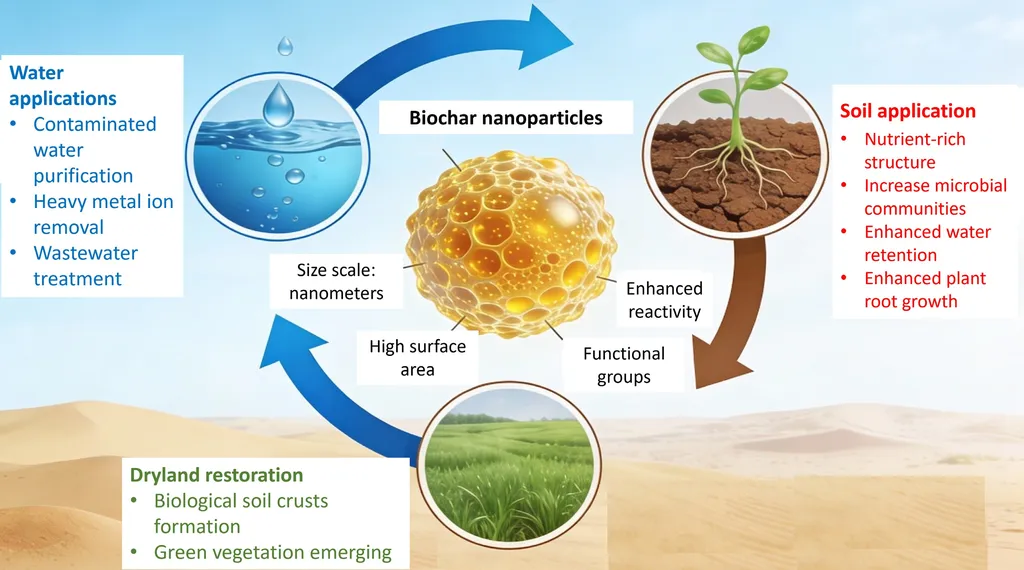
In the quest for sustainable solutions to environmental pollution, researchers are turning to an ancient material with a modern twist: biochar and its nano-scale counterpart, nanobiochar. A recent review published in *Discover Environment* (translated from the original title ‘Ekologijos Atradimai’) sheds light on the potential of these carbon-rich substances to revolutionize soil and water treatment, offering a beacon of hope for the energy sector and beyond.
Biochar, a carbonaceous material produced from the pyrolysis of biomass, has gained traction as an eco-friendly pollutant remover. But what sets it apart is its nano-scale derivative, nanobiochar (NBC), which packs a punch in terms of surface area and pollutant removal efficiency. “NBC produced at higher temperatures showed a markedly greater surface area due to the removal of volatiles and formation of porous structures,” explains lead author Remya R. Chandran from the Department of Chemistry at Maharaja’s College.
The review delves into the synthesis, surface modification, and characterization of biochar and NBC, with a special focus on property modification techniques like chemical oxidation and CO2 activation. These techniques enhance the surface functionality and porosity of biochar, making it more effective in adsorbing pollutants. The influence of pyrolysis temperature and biomass type on the physicochemical characteristics of NBC is also critically examined, linking these properties to pollutant removal efficiency.
One of the key findings is the higher negative zeta potential of NBC, which reflects enhanced dispersibility and colloidal stability compared to conventional biochar. This property is crucial for its application in water and soil treatment, where it can effectively remove emerging contaminants such as volatile organic compounds and heavy metals.
The review also addresses the environmental applications of biochar and NBC-based composites, highlighting their effectiveness in pollution control. Moreover, it evaluates regeneration strategies for spent biochar, emphasizing their significance in reducing secondary pollution risks and enabling the recovery of adsorbed pollutants for potential reuse.
The implications of this research are far-reaching, particularly for the energy sector. As the world grapples with the challenges of climate change and environmental degradation, the need for sustainable and scalable solutions has never been greater. Biochar and NBC offer a promising avenue for integrating biomass valorization with pollution control, advancing modification and regeneration techniques, and promoting sustainable resource management.
“By advancing modification and regeneration techniques, biochar and NBC can play a pivotal role in promoting sustainable resource management and supporting circular economy practices,” Chandran adds.
As we look to the future, the potential of biochar and NBC-based composites in environmental remediation is immense. This research not only underscores the versatility of these materials but also paves the way for innovative solutions that can shape the future of the energy sector and beyond. With further advancements in technology and a deeper understanding of these materials, we can expect to see biochar and NBC playing a central role in our quest for a cleaner, more sustainable world.