
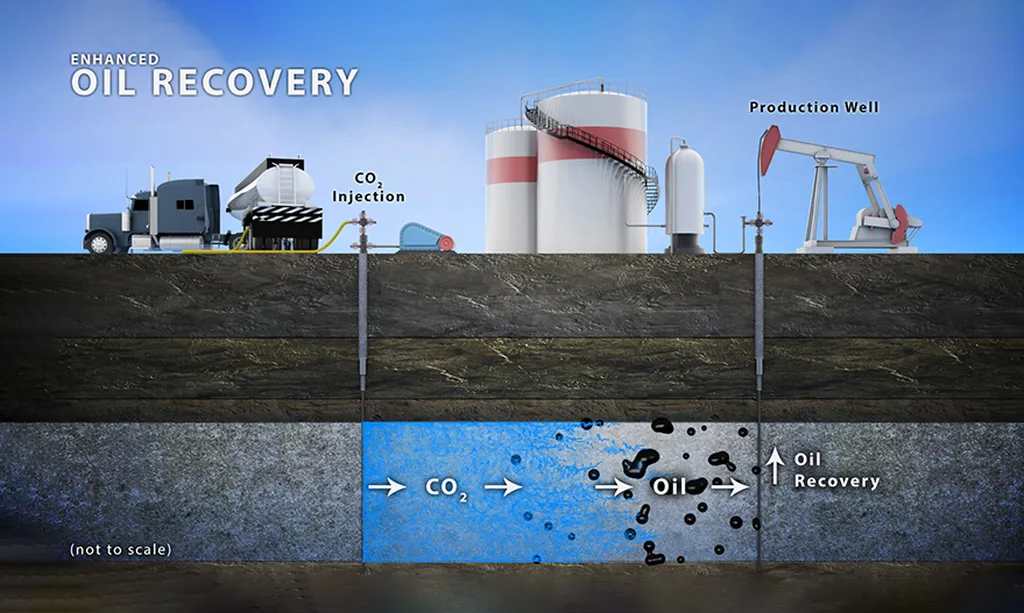
In the quest to balance energy security with environmental sustainability, researchers are turning to innovative technologies that can unlock the potential of unconventional oil and gas reservoirs while simultaneously reducing carbon emissions. A recent study published in *Youqi dizhi yu caishoulu* (translated as “Oil & Gas Geology and Recovery”) sheds light on the promising role of CO2-enhanced oil recovery (CO2-EOR) technologies in achieving these dual goals.
Unconventional oil and gas reservoirs, known for their low permeability and complex structures, have long posed challenges to conventional extraction methods. However, CO2-EOR technologies are emerging as a game-changer. According to the study led by TAO Lei from the College of Petroleum and Natural Gas Engineering at Changzhou University, CO2’s unique supercritical properties can significantly enhance reservoir development performance through various techniques such as cyclic huff-and-puff, displacement, fracturing, heat exchange, and CO2-assisted imbibition.
“The interfacial interactions among CO2, crude oil, formation water, and reservoir rocks are the core controlling factors affecting displacement efficiency,” explains TAO Lei. This intricate interplay necessitates precise regulation tailored to the specific conditions of each reservoir, including heterogeneity, temperature, and pressure.
Despite the promise, the implementation of CO2-EOR faces several hurdles. Uneven distribution of CO2 sources, high transportation costs, strong reservoir heterogeneity, and underdeveloped carbon capture, utilization, and storage (CCUS) infrastructure are among the key challenges. To overcome these obstacles, the study advocates for advancements in high-efficiency and low-energy CO2 capture technologies, optimization of flooding and storage parameters, and the establishment of robust carbon market mechanisms supported by policy frameworks.
The potential commercial impacts for the energy sector are substantial. CO2-EOR technology not only enables the efficient development of unconventional oil and gas resources but also contributes to carbon neutrality goals. This dual advantage is crucial for the ongoing energy transition, offering a pathway to meet global commitments while ensuring energy security.
As the world navigates the complexities of the energy transition, research like this provides a roadmap for integrating innovative technologies into the energy mix. By addressing the technical bottlenecks and fostering a supportive policy environment, the energy sector can harness the full potential of CO2-EOR, paving the way for a more sustainable and secure energy future.