
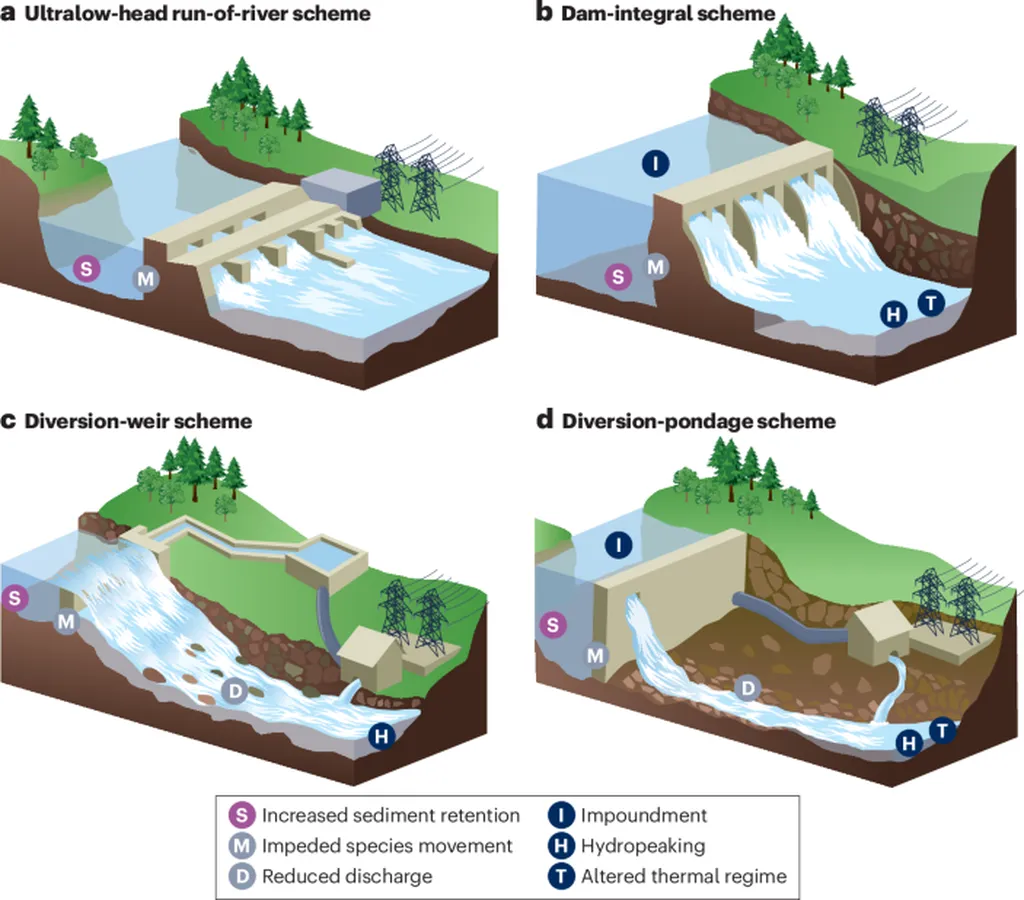
In the heart of mountainous catchments, a silent disruptor is altering the delicate balance of headwater streams: low-head dams. These structures, often overlooked, are significantly impacting the biodiversity and ecological functions of these vital waterways. A recent study published in the journal *Ecological Indicators* (translated as *Ecological Indicators*), led by Yuzhou Zhang from the School of Ecology and Environment at Anhui Normal University in China, sheds light on how these dams influence macroinvertebrate communities, offering crucial insights for the energy sector and environmental management.
Headwater streams are the lifeblood of river basins, playing pivotal roles in water retention, purification, and maintaining ecological connectivity. However, the prevalence of low-head dams in these areas is causing notable changes in the physical habitat and, consequently, the biodiversity of these streams. Zhang and his team investigated how these dams affect macroinvertebrate communities by comparing undisturbed upstream reaches with impoundment sites upstream of dams and scouring sites downstream.
The study revealed stark differences in physical habitat conditions among these site types. Impoundment reaches, characterized by slower flow, wider channels, and finer sediments, fostered communities dominated by long-lived, large-bodied, burrowing taxa with low drift propensity. In contrast, scouring reaches, marked by high current velocities, exposed substrates, and increased presence of artificial materials, supported small-bodied, highly mobile taxa with strong swimming ability and filter-feeding strategies.
“The changes in community composition and functional traits are a direct response to the altered environmental conditions caused by the dams,” explained Zhang. “This highlights the deterministic role of environmental filtering under these altered hydrological conditions.”
The findings underscore the importance of considering functional traits in sustainable management practices. By understanding how different species respond to environmental changes, managers can better predict the ecological consequences of low-head dams and develop strategies to mitigate their impacts.
For the energy sector, which often relies on low-head dams for hydroelectric power, this research provides a critical perspective on the broader ecological impacts of these structures. As the demand for renewable energy grows, so does the need for sustainable practices that balance energy production with environmental conservation. This study offers a trait-based approach to assessing and managing the ecological health of headwater streams, ensuring that energy projects do not come at the expense of biodiversity.
“The energy sector must consider the ecological impacts of their projects,” said Zhang. “By incorporating functional trait perspectives into their management practices, they can help conserve biodiversity and maintain ecosystem functioning in regulated headwater systems.”
This research not only advances our understanding of the ecological consequences of low-head dams but also paves the way for more informed and sustainable management practices. As the energy sector continues to evolve, the insights from this study will be invaluable in shaping policies and practices that support both energy production and environmental conservation.