
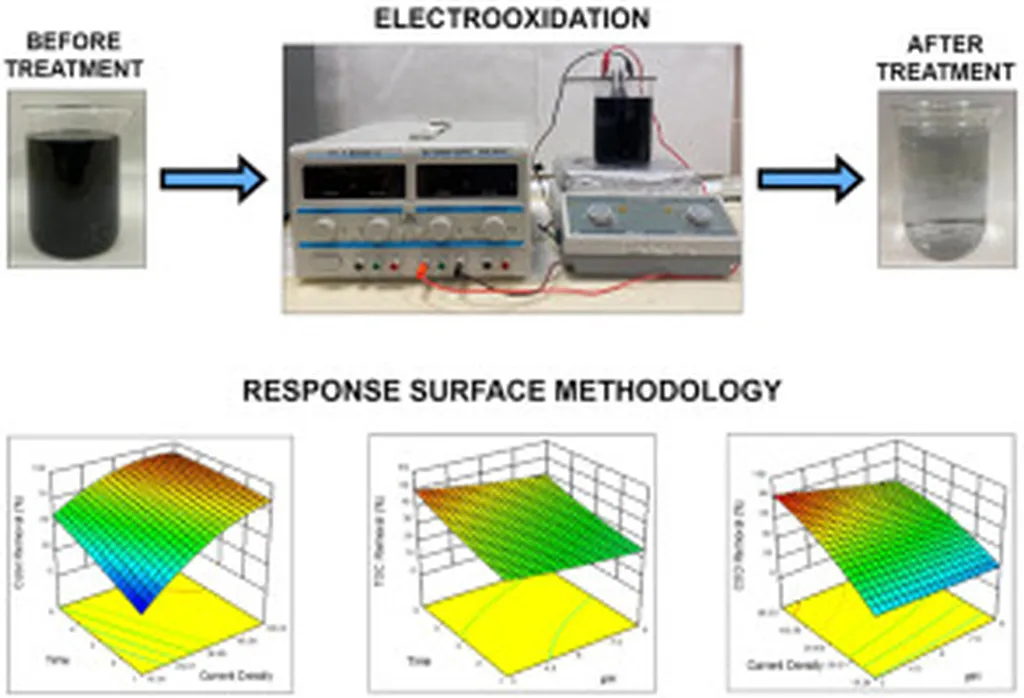
In the quest to tackle one of the most pressing environmental challenges facing the textile industry, researchers have turned to advanced treatment technologies that promise to revolutionize how we manage textile wastewater. A recent study published in *Clean Technologies* and led by Milena Espinosa from the Fiber Materials and Environmental Technologies (FibEnTech-UBI) at the University of Beira Interior in Portugal, offers a critical review of electrooxidation (EO) and membrane processes as promising solutions for treating textile wastewater (TWW).
The textile industry is notorious for its heavy water consumption and the generation of highly complex wastewater laden with dyes, organic compounds, salts, and heavy metals. Conventional treatment methods often fall short in addressing these pollutants effectively. Espinosa and her team have explored how EO and membrane technologies can fill this gap, offering a more efficient and sustainable approach.
“Electrooxidation and membrane processes have shown great potential for removing dyes, organic matter, and salts from textile wastewater,” Espinosa explains. “When combined, these technologies can achieve synergistic effects, enhancing pollutant degradation, reducing fouling, and improving water recovery.”
The study highlights the mechanisms, advantages, and limitations of these advanced treatment methods. EO, for instance, leverages electrical currents to break down pollutants, while membrane processes filter out contaminants. When integrated, these systems can significantly improve treatment efficiency, making them attractive for industrial applications.
One of the key challenges addressed in the research is the energy consumption associated with these processes. “Optimizing hybrid configurations is crucial to ensure cost-effectiveness and scalability,” Espinosa notes. “We also need to focus on the durability of electrode and membrane materials, as well as the management of concentrate generated during treatment.”
The implications for the energy sector are substantial. As industries strive to meet increasingly stringent environmental regulations, the adoption of advanced treatment technologies like EO and membrane processes could become a game-changer. These methods not only help in compliance but also open avenues for water reuse, reducing the overall water footprint of the textile industry.
Looking ahead, the research emphasizes the need for further optimization and innovation in hybrid systems. “The future lies in developing circular water management strategies that are not only effective but also sustainable and economically viable,” Espinosa concludes.
Published in *Clean Technologies*, this review serves as a comprehensive guide for researchers, industry professionals, and policymakers seeking to understand the current state and future potential of advanced treatment technologies in the textile sector. As the industry grapples with environmental challenges, the insights provided by Espinosa and her team could pave the way for more sustainable and efficient wastewater management practices.