
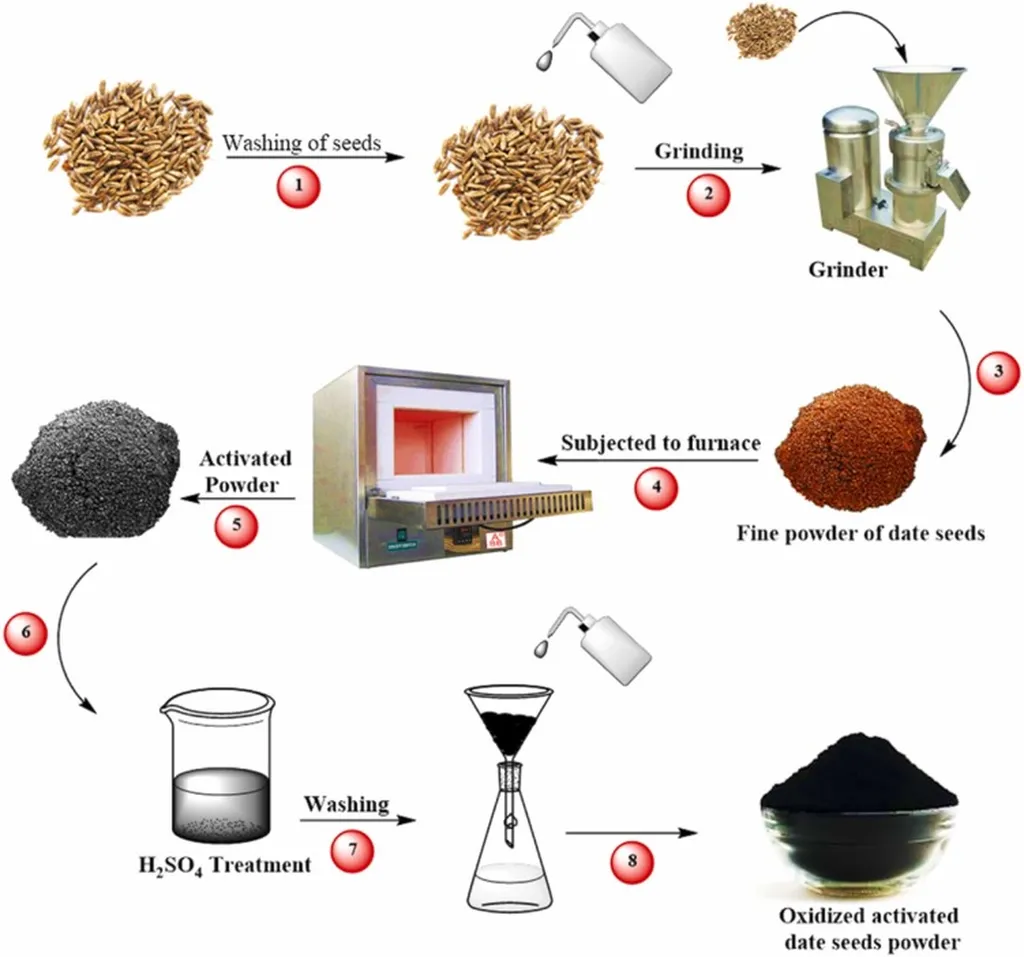
In a world grappling with water scarcity and contamination, a groundbreaking study offers a beacon of hope, transforming agricultural waste into powerful tools for water purification. Erfan Fazli, from the Department of Reclamation of Arid and Mountainous Regions at the University of Tehran, has pioneered a novel approach to nitrate removal using date seed powder and sawdust-derived biochars. This research, published in *Discover Water* (which translates to *Discover Water* in English), not only addresses critical environmental challenges but also opens new avenues for sustainable water treatment, particularly in resource-limited regions.
Nitrate contamination in water sources poses significant health risks and hampers agricultural productivity. Traditional treatment methods often require sophisticated and costly technologies, making them inaccessible for many communities. Fazli’s study introduces a cost-effective and locally available solution by leveraging agricultural waste—date seed powder and sawdust—as biosorbents for nitrate removal. “The idea was to find a sustainable and scalable solution that could be implemented in decentralized water treatment systems,” Fazli explains. “By converting these abundant wastes into effective adsorbents, we can address both environmental pollution and water scarcity.”
The study systematically compared raw and biochar derivatives of date seeds and sawdust, identifying the physicochemical features responsible for effective nitrate adsorption. Among the tested materials, date seed powder emerged as the standout performer, achieving an impressive removal efficiency of 89.95% within just 15 minutes. This rapid and high adsorption capacity of 1.41 mg/g (NO3−-N) at a dosage of 3.2 grams highlights the potential of date seed powder as a powerful biosorbent.
Adsorption modeling revealed that the Freundlich isotherm provided the best fit for date seed powder, indicating a heterogeneous and multilayer adsorption mechanism. Key Freundlich parameters for date seed powder (Kf = 0.007861, 1/n = 0.85, R2 = 0.9669) suggest strong adsorption affinity and favorable interaction with nitrate ions. “These findings not only demonstrate the efficacy of date seed powder but also provide a deeper understanding of the adsorption process, which is crucial for optimizing treatment strategies,” Fazli notes.
The implications of this research extend beyond environmental benefits. By utilizing locally available and low-cost materials, this approach offers a sustainable alternative for decentralized water treatment systems. This is particularly relevant for arid and semi-arid regions, where access to advanced treatment technologies is limited. “This study underscores the importance of leveraging agricultural waste for water treatment, providing a practical and scalable solution for communities in need,” Fazli adds.
The commercial impacts of this research are significant. The energy sector, which often relies on water-intensive processes, stands to benefit from more efficient and cost-effective water treatment methods. By reducing the need for expensive and energy-intensive treatment technologies, this approach can lower operational costs and enhance sustainability. Additionally, the use of agricultural waste as biosorbents aligns with circular economy principles, promoting resource efficiency and waste reduction.
As the world continues to grapple with water scarcity and contamination, innovative solutions like those presented by Fazli’s research are crucial. By transforming agricultural waste into powerful tools for water purification, this study not only addresses immediate environmental challenges but also paves the way for future developments in sustainable water treatment. The findings published in *Discover Water* offer a compelling case for the adoption of low-cost, locally available adsorbents, supporting safe water reuse and contributing to global efforts towards water security.