
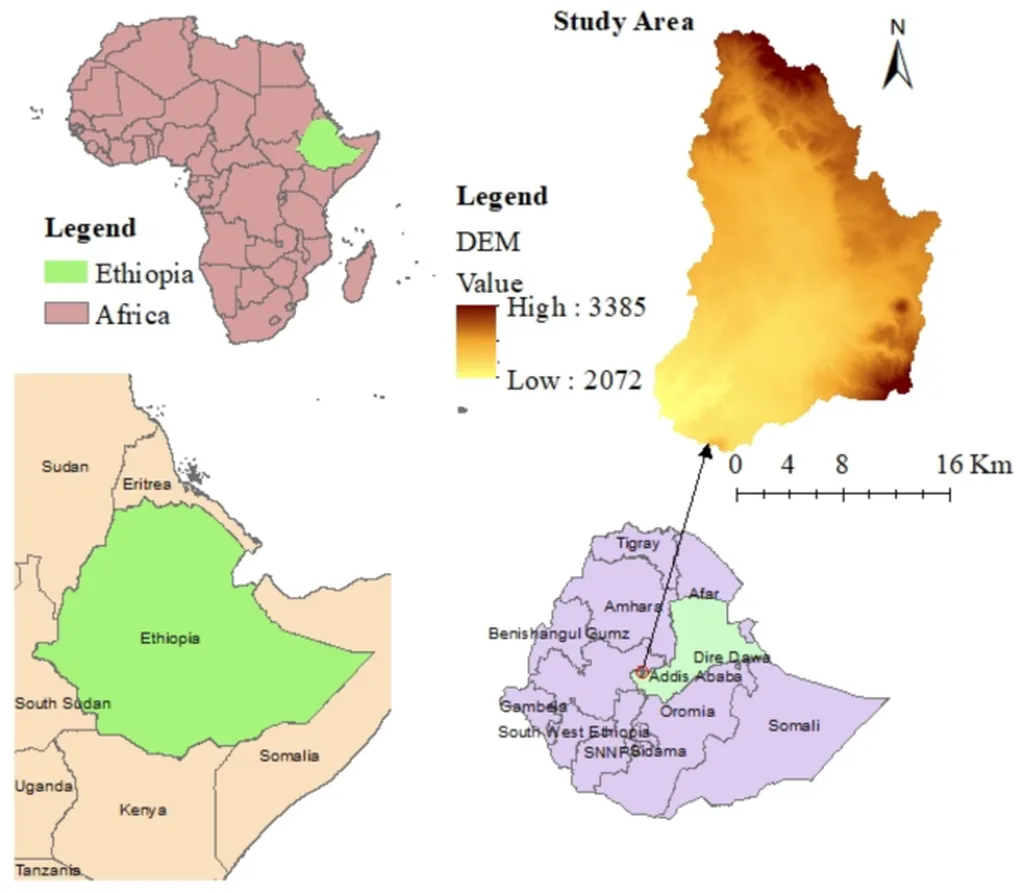
In the heart of Ethiopia’s Gambela region, a silent transformation is unfolding, one that could hold vital lessons for sustainable land management and agricultural productivity. A recent study, led by Shimeles Damene from the School of Development Studies at Addis Ababa University, has shed light on the intricate relationship between land use changes and soil quality in the Lower Alwero watershed. The research, published in the journal ‘Discover Sustainability’ (which translates to ‘Nachhaltigkeit entdecken’ in German), offers a compelling narrative that resonates beyond the borders of Ethiopia, particularly for sectors like agriculture and energy that depend on the health of our soils.
The study, which analyzed 131 disturbed and 58 undisturbed soil samples, reveals a stark reality: the quality of soil is significantly influenced by the type of land use and cover. “We found that soil quality indicators vary considerably across different land use types,” Damene explains. “Natural forests and grasslands, for instance, maintain the highest soil quality, while mechanized farmlands show a notable decline, primarily due to intensive tillage and nutrient depletion.”
The research identified seven key soil quality indicators—total nitrogen, cation exchange capacity, exchangeable calcium, exchangeable magnesium, available phosphorus, and bulk density—that are critical for monitoring soil health. These indicators could serve as a benchmark for future land use planning and management strategies.
The implications of this research are far-reaching, particularly for the energy sector. As the world grapples with the need for sustainable bioenergy, understanding the impact of land use changes on soil quality becomes paramount. “Soil health is intrinsically linked to agricultural productivity,” Damene notes. “By maintaining soil quality, we can enhance crop yields, which in turn supports the bioenergy sector.”
Moreover, the study underscores the importance of integrating indigenous land management practices into policy design. “Traditional conservation practices have a role to play in maintaining soil quality,” Damene says. “These practices, often overlooked, can provide valuable insights for sustainable land management.”
The research also highlights the need for regular soil assessment and conservation-based agriculture. By adopting these practices, stakeholders can ensure environmental resilience and agricultural productivity, even in the face of widespread land conversion.
As we look to the future, this study serves as a reminder of the delicate balance between land use and soil health. It challenges us to rethink our approaches to land management, emphasizing the need for sustainable practices that can support both agricultural productivity and environmental resilience. In doing so, we can pave the way for a more sustainable future, one that benefits not just the energy sector, but all those who depend on the health of our soils.