
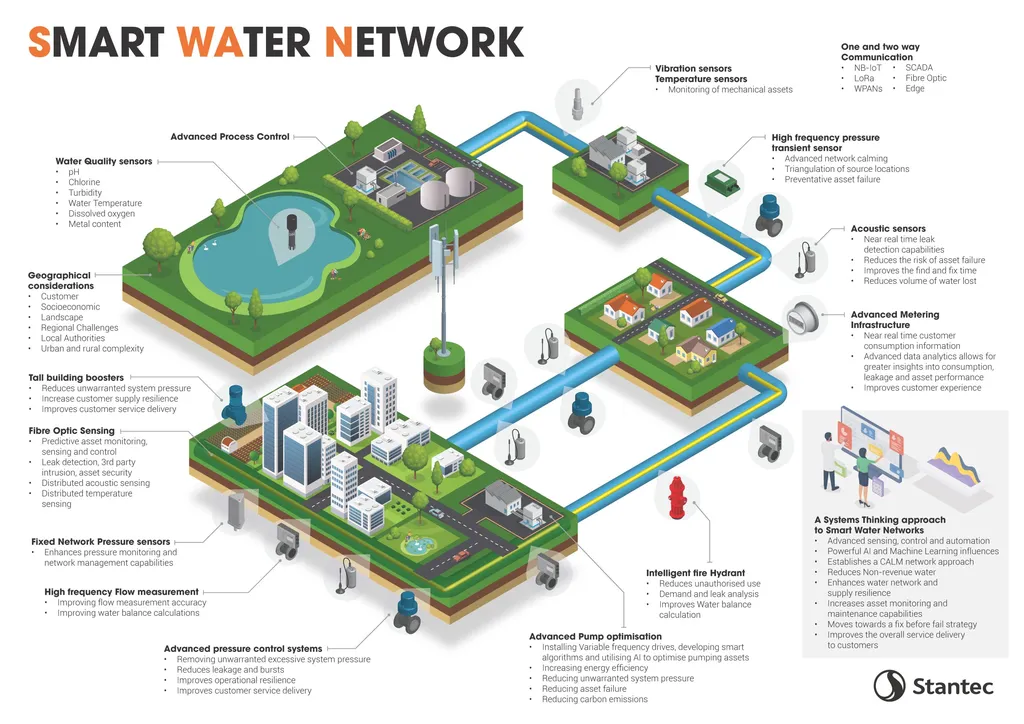
In the quest to optimize water distribution networks, researchers have turned to artificial intelligence to detect and locate abnormal water consumption with unprecedented accuracy. A recent study led by João Caetano from the CERIS Instituto Superior Técnico at the University of Lisbon introduces a topology-aware neural network approach that promises to revolutionize how water utilities monitor and manage their systems.
Water distribution networks are complex systems prone to leaks, bursts, and unauthorized usage, all of which can lead to significant water loss and financial strain. Traditional methods of detecting these issues often rely on manual inspections and reactive measures, which can be time-consuming and costly. Caetano’s research offers a proactive solution by leveraging advanced metering systems and neural networks to identify and locate abnormal consumptions in real-time.
The approach involves two key steps: optimizing the placement of pressure sensors to maximize measurement sensitivity and developing metamodels that predict consumptions at all nodes based on pressure measurements and smart meter data. “The Static Metamodel assumes constant nodal consumption, while the Dynamic Metamodel accounts for daily variations, making it more adaptable to real-world scenarios,” explains Caetano. This dual-model approach allows for more accurate detection and location of abnormal consumptions, depending on the number and spatial distribution of sensors.
The implications for the water and energy sectors are substantial. By quickly identifying and addressing abnormal consumptions, utilities can reduce water loss, minimize financial losses, and improve overall system efficiency. “As water utilities implement advanced metering systems, the application of this approach becomes more viable, enabling more effective and faster abnormal consumption detection,” Caetano notes.
The study, published in the journal ‘Water Resources Research’ (translated to English as ‘Research on Water Resources’), highlights the potential for this technology to shape future developments in water management. The research not only enhances the ability to detect and locate issues but also provides a framework for integrating advanced technologies into existing infrastructure. This could lead to more resilient and efficient water distribution networks, ultimately benefiting both utilities and consumers.
As the water sector continues to evolve, the adoption of such innovative technologies will be crucial in addressing the challenges of water scarcity and sustainability. Caetano’s work represents a significant step forward in this direction, offering a glimpse into the future of smart water management.