
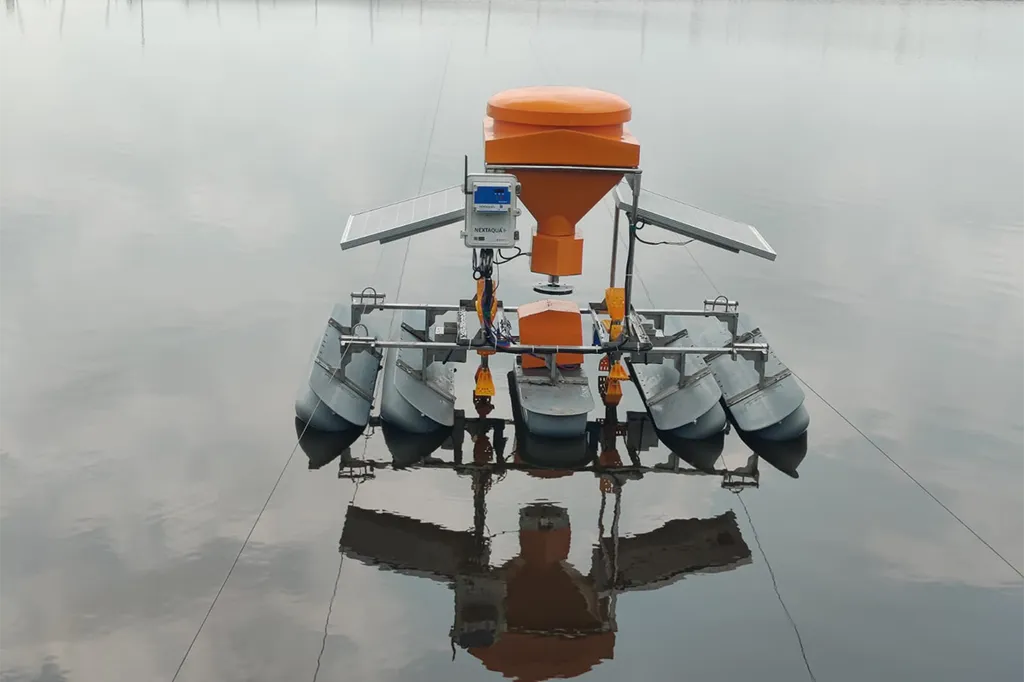
In the heart of India’s bustling tech scene, a groundbreaking development is making waves—not just in the digital world, but in the very waters where shrimp are farmed. P. Rohini, a researcher from the Department of Computer Science and Engineering at Vel Tech Rangarajan Dr. Sagunthala R&D Institute of Science and Technology in Chennai, has spearheaded a project that could revolutionize the global aquaculture industry. The research, published in IEEE Access (translated as “IEEE Open Access”), introduces a unified framework that combines the Internet of Things (IoT) and Artificial Intelligence (AI) to create a real-time monitoring and disease prediction system for sustainable aquaculture.
The global shrimp aquaculture industry is no stranger to challenges. Fluctuations in water quality, disease outbreaks, and the inefficiencies of manual monitoring have long plagued farmers, leading to significant economic losses and environmental concerns. Rohini’s innovative solution addresses these issues head-on with a custom-designed aqua buoy system that continuously measures critical parameters such as pH, Dissolved Oxygen (DO), and Oxidation Reduction Potential (ORP). This system uses a distributed IoT sensor network with cloud connectivity, ensuring that data is collected and transmitted in real-time.
“Our goal was to create a system that not only monitors water quality but also predicts potential disease outbreaks before they occur,” Rohini explains. The system’s responsive web dashboard and mobile application provide real-time visualization, farmer advisories, and automated alert notifications, enabling timely interventions that can save both time and resources.
The heart of this innovation lies in its use of machine learning models. Random Forest algorithms achieve an impressive 98.35% accuracy in disease prediction, while Random Forest regression minimizes manual calibration requirements by providing highly reliable pH voltage predictions. Additionally, Long Short-Term Memory (LSTM) networks are employed for time-series forecasting, achieving up to 94% accuracy in predicting pH, DO, and ORP trends. This predictive capability allows farmers to take early corrective actions, significantly reducing the risk of shrimp mortality.
The commercial impacts of this research are substantial. By enhancing monitoring efficiency and reducing the risk of disease outbreaks, the system supports environmentally sustainable farming practices. This not only benefits the aquaculture industry but also has broader implications for the energy sector, as sustainable practices can lead to more efficient use of resources and reduced environmental impact.
Rohini’s work demonstrates the potential of combining IoT, disease classification, prediction, and automated calibration techniques to transform aquaculture into a data-driven, precision-managed, and resource-efficient industry. As the world increasingly turns to technology to solve complex problems, this research offers a glimpse into the future of sustainable farming.
“The integration of AI and IoT in aquaculture is just the beginning,” Rohini notes. “We are excited to see how this technology will evolve and the positive impact it will have on the industry and the environment.”
In a world where sustainability and efficiency are paramount, Rohini’s research stands as a testament to the power of innovation. By leveraging cutting-edge technology, she has not only addressed critical challenges in the aquaculture industry but also paved the way for a more sustainable and profitable future. As the research continues to gain traction, it is clear that the ripple effects of this work will be felt far and wide, shaping the future of farming and beyond.