
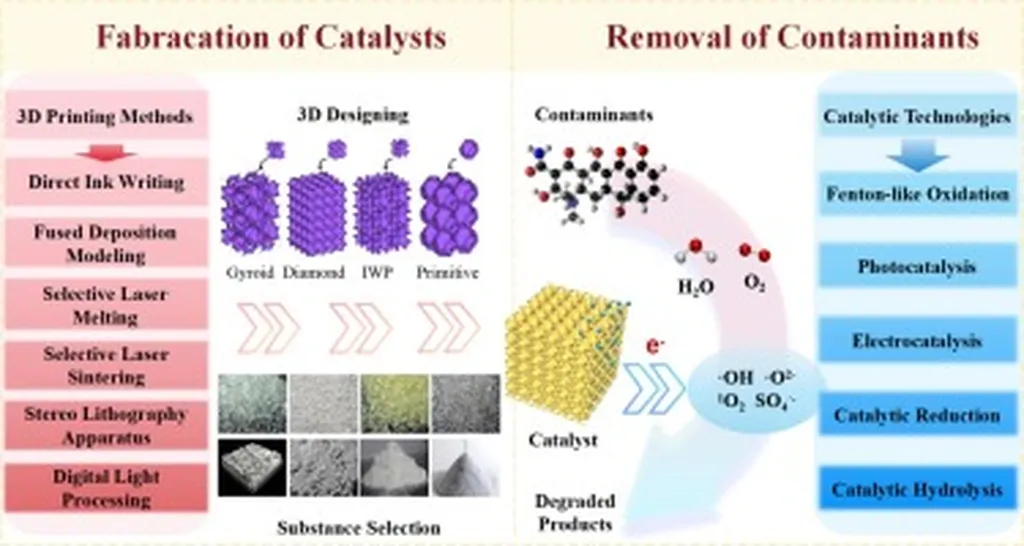
In the quest for innovative water treatment solutions, researchers have turned to an unlikely ally: 3D printing. A recent study published in *Discover Catalysis* (translated from Portuguese as “Discover Catalysis”) explores how 3D-printed carbon-based catalysts (3DPCCs) can revolutionize the ozonation process, offering a promising avenue for tackling recalcitrant organic pollutants. The research, led by José R. M. Barbosa of LSRE-LCM, ALiCE, Departamento de Engenharia Química at the Universidade do Porto, sheds light on the potential of additive manufacturing to transform the water treatment landscape.
The study focuses on the ozonation of oxalic acid (OxAc), a stubborn organic compound that has long posed challenges for water treatment facilities. Traditional powder catalysts have shown promise but often fall short due to mechanical instability and inefficiency in large-scale applications. Enter 3D printing, a technology that allows for the creation of macrostructured catalysts with enhanced durability and performance.
Barbosa and his team designed a novel stirrer equipped with a perforated case, operated at 200 rpm in a semi-batch reactor setup. This ingenious design significantly improved the mechanical stability of the 3DPCCs, enabling a 90% removal rate of OxAc within 180 minutes. “The key was optimizing the system to match the unique properties of 3D-printed catalysts,” Barbosa explained. “By adjusting the reactor setup, we were able to unlock their full potential.”
The implications for the water treatment industry are substantial. The ability to efficiently degrade recalcitrant pollutants using 3D-printed catalysts could lead to more sustainable and cost-effective treatment processes. This technology could be particularly beneficial for industrial facilities and municipalities grappling with complex wastewater streams.
Beyond water treatment, the research has broader implications for the energy sector. The same principles could be applied to develop advanced catalysts for energy generation and storage, potentially improving the efficiency of processes like fuel cells and electrolyzers. “This is just the beginning,” Barbosa noted. “The versatility of 3D printing opens up a world of possibilities for catalyst design and optimization.”
As the field of additive manufacturing continues to evolve, so too will its applications in catalysis and water treatment. The study published in *Discover Catalysis* serves as a testament to the power of innovation, demonstrating how cutting-edge technologies can address longstanding challenges in environmental engineering. With further research and development, 3D-printed catalysts could become a cornerstone of sustainable water treatment and energy solutions, paving the way for a cleaner, more efficient future.