
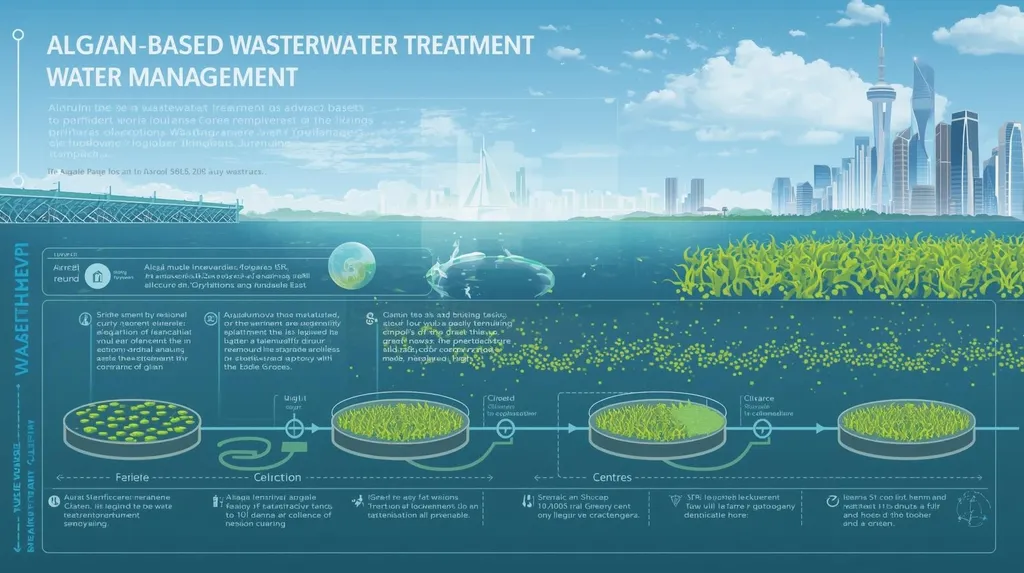
In a groundbreaking development for sustainable wastewater treatment, researchers have transformed agricultural waste into a high-performance membrane material, offering a promising solution for municipal water treatment challenges. Yazan Abuhasheesh, a researcher at the Department of Chemical and Petroleum Engineering, Khalifa University of Science and Technology, led a study that converted microalgae biomass into amine-functionalized biochar (AFBC) and incorporated it into cellulose acetate membranes. This innovation, published in the journal ‘Biochar’ (which translates to ‘Charcoal’ in English), could significantly impact the water treatment industry and contribute to the circular economy.
The research team employed a one-step mussel-inspired polymerization and Schiff-base addition reaction to functionalize biochar with amine groups. This process enhanced the biochar’s properties, making it an ideal filler for cellulose acetate membranes. The resulting hybrid membranes demonstrated remarkable improvements in hydrophilicity, porosity, and surface charge, leading to enhanced rejection of natural organic matter (NOM).
“Our modified membrane containing 4 wt.% AFBC achieved a flux of 169.1 LMH and 64.1% NOM removal efficacy during municipal wastewater filtration,” Abuhasheesh explained. “This is a significant improvement over the pristine cellulose acetate membrane, which only achieved 81.8 LMH and 31.1% removal.”
The enhanced performance of these hybrid membranes extends beyond NOM removal. They also demonstrated complete bacterial removal, partial elimination of other contaminants, and excellent antifouling properties with a high flux recovery ratio of 82.7%. These attributes make the membranes highly suitable for sustainable and efficient municipal wastewater treatment.
The commercial implications of this research are substantial. As water scarcity and pollution continue to pose global challenges, the demand for advanced and sustainable water treatment technologies is growing. The use of agricultural waste to create high-performance membrane materials aligns with the principles of the circular economy, reducing waste and lowering the environmental impact of water treatment processes.
“This research opens up new possibilities for the valorization of agricultural waste and the development of eco-friendly water treatment technologies,” Abuhasheesh noted. “It’s a step towards a more sustainable future for the water industry.”
The findings of this study could shape future developments in the field of water treatment, particularly in the design and application of mixed matrix membranes (MMMs). By incorporating functionalized biochar into membrane materials, researchers can enhance the performance and sustainability of water treatment processes, ultimately contributing to the energy sector’s goal of reducing its environmental footprint.
As the world seeks innovative solutions to address water challenges, this research offers a promising avenue for the development of advanced, sustainable, and cost-effective water treatment technologies. The integration of biochar-derived materials into membrane technology represents a significant advancement in the field, paving the way for more efficient and environmentally friendly water treatment solutions.