
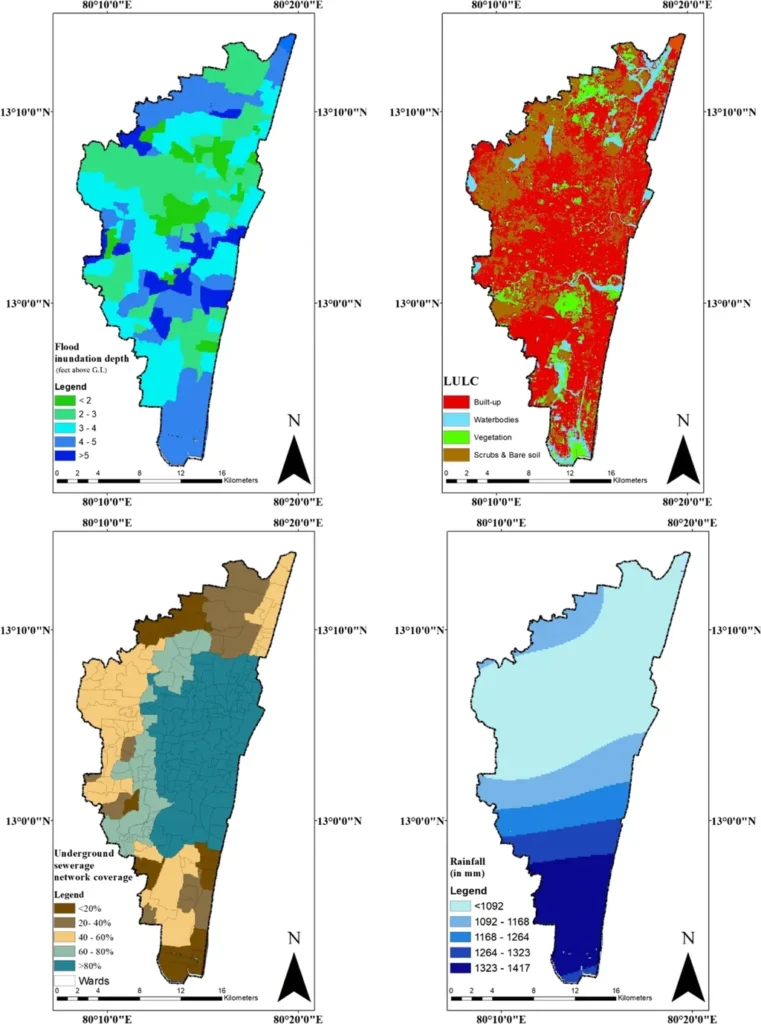
In the heart of Chennai, India, a critical battle against urban flooding is unfolding, and a recent study published in *Nature Environment and Pollution Technology* (translated as *Nature, Environment, and Pollution Technology*) is shedding new light on the challenges and solutions. The research, led by H. Sylasri and R. Shanmuga Priyan, focuses on the Pallikaranai Marshland and the Buckingham Canal corridor, areas that have become increasingly vulnerable to flooding due to climate change and rapid urbanization.
The study employs a sophisticated approach combining the Analytic Hierarchy Process (AHP) with Geographic Information Systems (GIS) to assess flood hazards. By integrating various geospatial factors such as rainfall, Digital Elevation Models (DEM), slope, Land Use Land Cover (LULC), river distance, flow length, and the Normalized Difference Water Index (NDWI), the researchers have developed a comprehensive Flood Hazard Index (FHI). This index allows for the creation of detailed flood hazard maps, identifying critical areas at risk.
“Urban growth has led to extensive wetland degradation, increased surface runoff, and more frequent flooding, especially during intense rainfall,” explains lead author H. Sylasri. The study highlights how changes in land cover directly influence the intensity and frequency of flooding, underscoring the urgent need for sustainable urban planning and climate-resilient infrastructure.
The implications of this research are far-reaching, particularly for the energy sector. Flooding can disrupt power generation, transmission, and distribution, leading to significant economic losses. By identifying high-risk areas, the study provides a scientific foundation for developing targeted flood management strategies. This proactive approach can help mitigate risks, reduce downtime, and ensure the reliability of energy infrastructure.
Moreover, the integration of deep-learning frameworks, such as convolutional neural networks, has shown high predictive capability for regional flood susceptibility. This advancement opens new avenues for more accurate and timely flood forecasting, enabling better preparedness and response.
As urban areas continue to expand, the need for resilient infrastructure becomes paramount. The findings of this study offer a roadmap for policymakers, urban planners, and energy sector stakeholders to enhance flood resilience and protect critical infrastructure. By prioritizing wetland conservation and sustainable urban planning, communities can better adapt to the challenges posed by climate change and urbanization.
In conclusion, the research led by H. Sylasri and R. Shanmuga Priyan provides valuable insights into the complex interplay between urbanization, climate change, and flood hazards. Published in *Nature Environment and Pollution Technology*, this study not only advances our understanding of flood dynamics but also offers practical solutions for building a more resilient future. As the world grapples with the impacts of climate change, such research is crucial for shaping policies and strategies that safeguard communities and critical infrastructure.