
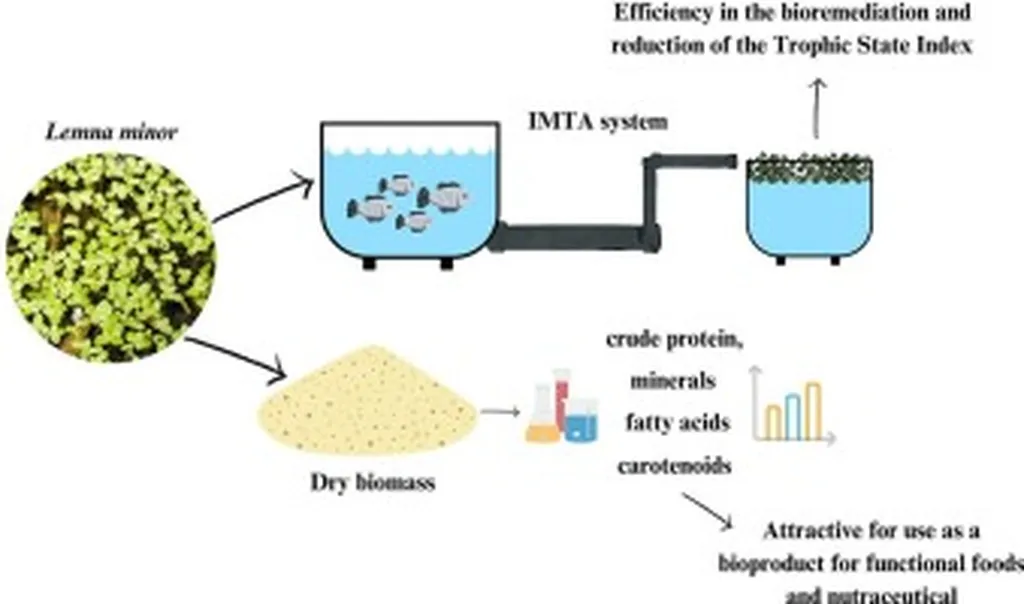
In the quest for sustainable solutions to tackle agro-industrial wastewater pollution, a trio of researchers has turned to an unlikely ally: duckweed. Shweta Surendra Chikhale, Girish R. Pathade, and Wasim R. Bagwan, have published a comprehensive review in the journal *Nature Environment and Pollution Technology* (translated as *Nature: Environmental Pollution and Technology*), highlighting the potential of duckweed (Lemna spp.) as a circular economy solution for treating nutrient-rich wastewaters.
The researchers emphasize that conventional treatment methods often fall short in reducing nutrient loads, leading to significant ecological and public health challenges. “Duckweed offers a promising alternative,” says lead author Shweta Surendra Chikhale. “It’s a fast-growing aquatic plant with an exceptional capacity for nutrient uptake, particularly nitrogen and phosphorus, while simultaneously producing protein-rich biomass suitable for animal feed.”
The review synthesizes findings from various studies, demonstrating the effectiveness of duckweed-based systems in reducing chemical oxygen demand (COD) and biological oxygen demand (BOD). By integrating these systems into circular economy models, the researchers propose a strategy that couples wastewater treatment with resource recovery. This approach not only addresses environmental concerns but also presents commercial opportunities for the energy and agricultural sectors.
One of the most compelling aspects of this research is its potential to enhance food-feed security. The protein-rich biomass produced by duckweed can be used as a valuable feedstock for livestock, creating a sustainable loop where waste is transformed into a resource. “This is a win-win situation,” explains co-author Girish R. Pathade. “We’re cleaning up wastewater and producing a valuable product that can be integrated into the food chain.”
However, the researchers acknowledge current limitations in system design, scalability, and long-term implementation. They highlight areas requiring further research, such as optimizing growth conditions and improving harvesting techniques. These challenges not only present opportunities for innovation but also underscore the need for interdisciplinary collaboration.
The implications of this research extend beyond the immediate environmental benefits. By adopting duckweed-based wastewater treatment systems, industries can reduce their environmental footprint while also tapping into new revenue streams. This aligns with the growing trend towards sustainability and circular economy practices, which are increasingly becoming a competitive advantage in the market.
As the world grapples with the dual challenges of environmental degradation and resource scarcity, innovative solutions like duckweed-based wastewater treatment offer a glimmer of hope. The research by Chikhale, Pathade, and Bagwan not only advances our understanding of this promising technology but also paves the way for future developments in the field. By embracing such sustainable practices, industries can contribute to a healthier planet while also securing their long-term prosperity.