
In the relentless pursuit of sustainable water solutions, a team of researchers has shed new light on the potential of membrane distillation (MD) for desalination and brine concentration. Led by Garudachari Bhadrachari and his team, this study, published in the journal *Nature Environment and Pollution Technology* (translated as *Nature: Environmental and Pollution Technology*), offers promising insights for the energy and water sectors.
The research focused on evaluating the performance of membrane distillation using various saline feeds, including fresh, brackish, seawater, and desalination brine from Kuwait. The team employed both electrical and solar heating methods to drive the process. Their findings revealed that brackish water exhibited higher water flux compared to seawater and brine, with salt rejection remaining unaffected by increased salinity. This is a significant observation, as it suggests that MD can handle a wide range of salinities without compromising efficiency.
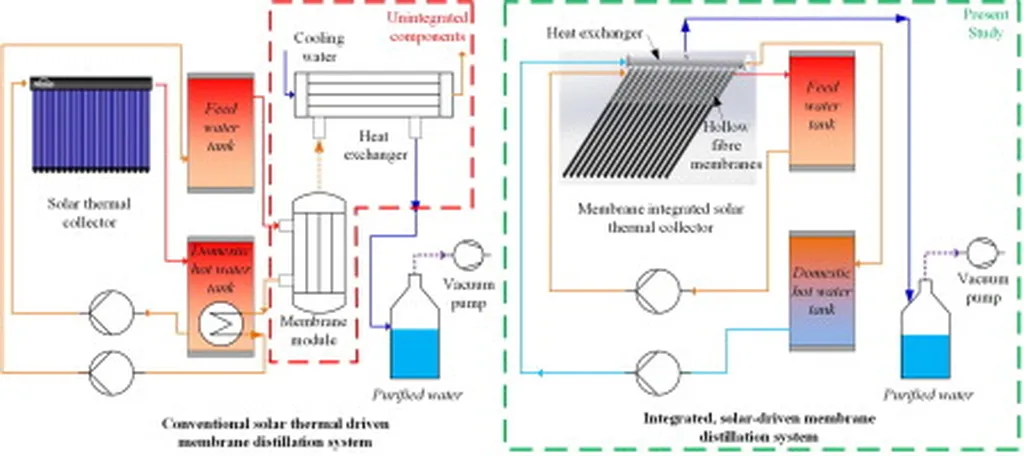
One of the most compelling aspects of this study is its exploration of solar-powered MD. “Solar mode operation of the MD system showed a water flux of 0.95 to 1 L.m²h⁻¹, with an average recovery of 2.75%,” noted lead author Garudachari Bhadrachari. This highlights the potential for solar desalination in remote areas and small-scale industrial waste treatment, where access to electricity is limited.
The study also found that energy consumption was more influenced by feed quantity than by salinity, a crucial factor for optimizing operational costs. The water flux ranged from 1.5 to 2 L.m²h⁻¹, with a water recovery of 3.3 to 4% in electrical heating mode. These results underscore the practical potential of MD for both desalination and brine concentration, offering a more energy-efficient alternative to traditional methods.
The implications for the energy sector are substantial. As the world grapples with water scarcity and the need for sustainable energy solutions, MD technology could play a pivotal role. “Our findings highlight the practical potential of MD for solar desalination and brine concentration in remote areas and small-scale industrial waste treatment,” Bhadrachari explained. This could lead to significant reductions in energy consumption and costs, making desalination more accessible and environmentally friendly.
The research team’s work is a stepping stone towards commercial viability for emerging desalination technologies. While challenges remain, the study provides a solid foundation for further exploration and development. As the world continues to seek innovative solutions to water and energy challenges, membrane distillation stands out as a promising technology with the potential to reshape the future of desalination.