
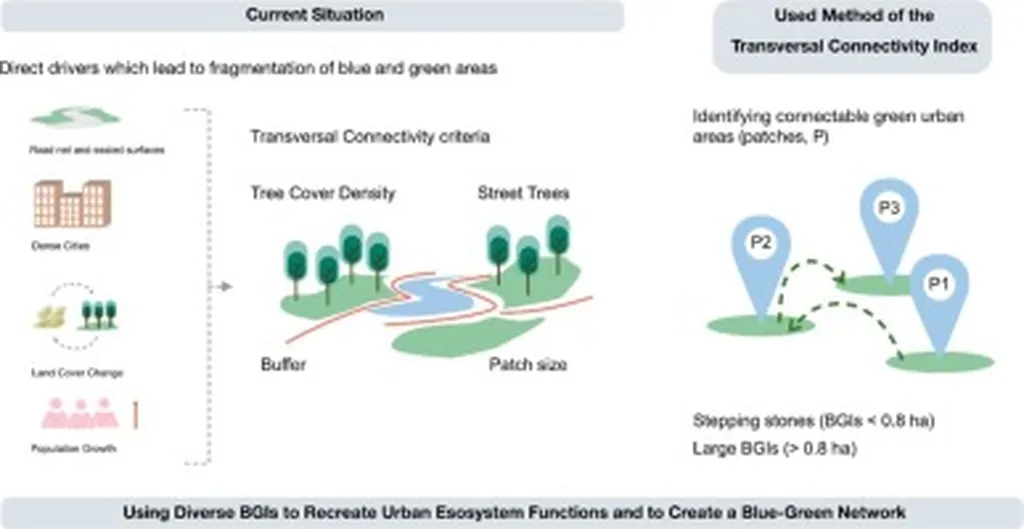
In the heart of Bavaria, a groundbreaking study is reshaping how cities approach urban planning and climate resilience. Led by Pia Schmitzer from the Landscape Architecture and Landscape Planning department at the Technical University of Munich, the research focuses on enhancing blue-green infrastructure (BGI) connectivity in Munich, with the Isar River as its central character. Published in the journal ‘City and Environment Interactions’ (Stadt und Umwelt Interaktionen), the study offers a blueprint for cities worldwide to bolster their ecosystems and improve urban living conditions.
The study tackles a critical issue: urbanization and transportation infrastructure often fragment blue-green landscapes, disrupting the vital connection between vegetated areas and surface water systems. This fragmentation limits ecosystem functions and services, making cities more vulnerable to climate change impacts. Schmitzer’s research introduces the Transversal Connectivity Index (TCI) as a novel approach to assess and improve BGI connectivity in the transversal dimension, extending laterally from the river.
Using open-source geospatial data, the team generated connectivity scenarios that pinpoint potential core areas for enhancing BGI. The findings are promising: up to 74 existing green urban areas in Munich could be connected to the BGI adjacent to the Isar River. Among these, 26 small patches, each under 0.8 hectares, can serve as crucial stepping stones, facilitating connectivity and boosting ecosystem services.
“The methodological approach used in this study demonstrates the vast possibilities of exploring BGI expansions and transversal connectivity for positively influencing ecosystem services in urban settings,” Schmitzer explains. These services include biodiversity conservation, climate regulation, and improved human well-being.
For the energy sector, the implications are significant. Enhanced BGI connectivity can mitigate urban heat islands, reducing the demand for energy-intensive cooling solutions. Additionally, improved green spaces can support renewable energy initiatives, such as solar farms integrated into landscapes, and enhance the overall resilience of urban infrastructure.
The study’s approach is not just limited to Munich. Its application to other metropolitan areas could provide a robust basis for urban BGI planning and management, ultimately sustaining and improving ecosystem services and benefits to human societies. As cities worldwide grapple with the impacts of climate change, Schmitzer’s research offers a beacon of hope and a practical pathway towards more resilient and sustainable urban environments.
In a world where urbanization and climate change are inextricably linked, this research underscores the importance of integrating nature-based solutions into urban planning. By doing so, cities can not only enhance their ecological health but also create more livable, resilient, and energy-efficient communities.