
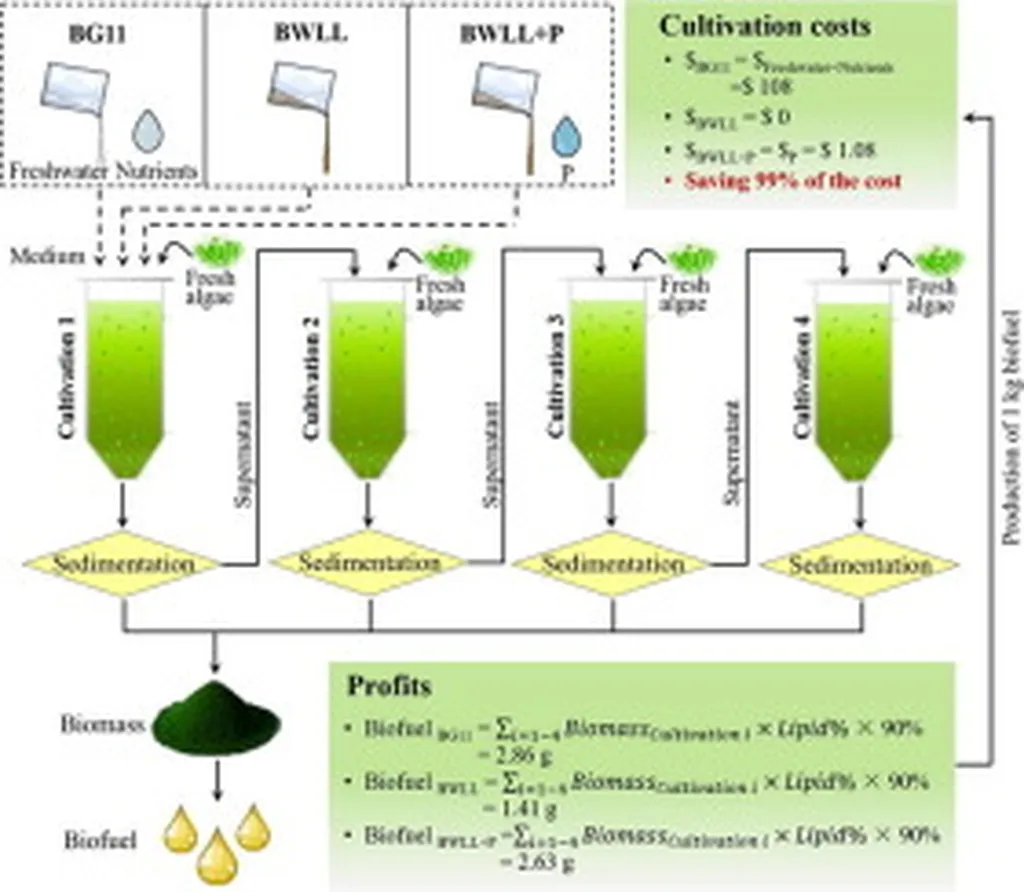
In a groundbreaking study published in *Water Cycle* (translated from Chinese as “Water Cycle”), researchers have developed an innovative approach to tackle the persistent challenge of domestic garbage leachate (DGL) treatment. Led by Xiaoyan Wang from the Beijing Key Lab for Source Control Technology of Water Pollution at Beijing Forestry University, the research introduces a dual-waste valorization strategy that not only addresses environmental concerns but also holds significant promise for the energy sector.
Domestic garbage leachate, a byproduct of landfills, is notorious for its complex organic toxins and high chromaticity, which limit the effectiveness of conventional treatment methods. Wang and her team have pioneered a method that uses rural sewage (RS)-diluted DGL for microalgal cultivation. This adaptive cultivation technique has shown remarkable results, with microalgal density reaching 2.88 × 10⁷ cells/mL in the LS5 group, which was diluted five-fold by RS.
The study employed a combination of single-factor experiments and response surface methodology to optimize the cultivation parameters. The optimal conditions were determined to be mixotrophic cultivation at an initial density of 6.5 × 10⁶ cells/mL in non-sterilized LS5 under continuous white light (2942 lux) for 20 days. “This optimized process not only enhances the efficiency of microalgal growth but also significantly reduces the environmental impact associated with conventional nutrient production,” Wang explained.
One of the most compelling aspects of this research is its life cycle assessment (LCA), which revealed that utilizing DGL avoids the upstream production burdens typically associated with conventional nutrients. The study identified water consumption and energy as primary contributors to environmental impact, highlighting areas for further improvement and innovation.
The implications of this research extend beyond wastewater treatment. The energy sector, in particular, stands to benefit from this waste-to-resource conversion technology. Microalgae cultivated under these optimized conditions can be harnessed for biofuel production, offering a sustainable and renewable energy source. “By converting waste into a valuable resource, we are not only addressing environmental challenges but also contributing to the development of a circular economy,” Wang noted.
This study represents a significant step forward in the field of environmental sustainability. As the world grapples with the dual challenges of waste management and energy production, innovative solutions like this one offer hope for a more sustainable future. The research published in *Water Cycle* underscores the potential of technological advancements to drive environmental and economic benefits, paving the way for broader ecological advantages beyond localized wastewater treatment.
As the energy sector continues to seek sustainable solutions, the findings from this study could shape future developments in biofuel production and waste management. The integration of microalgal cultivation with DGL treatment not only enhances environmental sustainability but also opens new avenues for commercial applications in the energy sector. This research serves as a testament to the power of innovation in addressing global challenges and promoting a circular economy.