
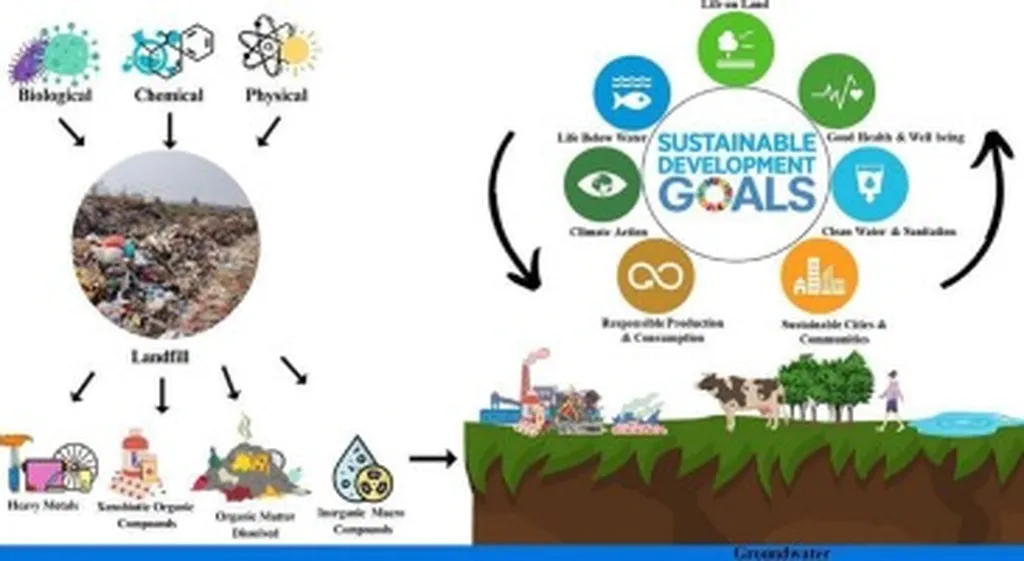
In the shadow of every landfill lies a ticking time bomb of environmental and public health risks, primarily in the form of landfill leachate (LL). This complex and hazardous effluent, brimming with contaminants, has long posed a significant challenge to wastewater treatment management. However, a recent review published in *Ecotoxicology and Environmental Safety* (which translates to *Safety and Environmental Toxicology* in English) offers a glimmer of hope, presenting integrated treatment strategies that could revolutionize the way we manage LL and even recover valuable resources.
At the helm of this research is Mohamed T. El-Saadony, a distinguished researcher from the Department of Agricultural Microbiology at Zagazig University in Egypt. El-Saadony and his team have critically evaluated conventional and advanced LL treatment technologies, shedding light on the most effective methods for tackling this persistent environmental issue.
The review contends that integrated treatment systems, such as membrane bioreactors (MBRs) combined with advanced oxidation processes, are essential for managing the variable and recalcitrant nature of LL. “By aligning treatment strategies with circular economy principles, we can simultaneously remove pollutants and recover valuable resources like water, nutrients, and energy,” El-Saadony asserts.
The study reveals that while advanced systems like MBRs and reverse osmosis (RO) achieve high effluent quality, their sustainability is often undermined by substantial energy demands and the generation of secondary waste streams. This is where the energy sector comes into play. The high energy demands of these advanced treatment processes present both a challenge and an opportunity for innovation in energy-efficient technologies.
El-Saadony and his team propose that hybrid systems, which employ biological processes for bulk removal followed by advanced polishing steps, offer a more balanced approach to cost-effective and environmentally sound management. “Future research should prioritize the development of low-energy hybrid processes, integrated with real-time ecotoxicological monitoring, to achieve zero-liquid discharge and advance sustainable LL management,” El-Saadony emphasizes.
The commercial implications of this research are profound. As the world increasingly embraces circular economy principles, the ability to recover valuable resources from LL could open up new revenue streams for wastewater treatment facilities. Moreover, the development of energy-efficient treatment technologies could significantly reduce operational costs, making these facilities more competitive and attractive to investors.
The study also highlights the importance of regulatory frameworks in driving the adoption of advanced treatment technologies. As governments around the world strive to mitigate environmental and human health risks, the implementation of stringent regulations could accelerate the development and deployment of innovative LL treatment solutions.
In conclusion, this research offers a compelling vision for the future of LL management, one that is not only environmentally sustainable but also economically viable. By integrating advanced treatment technologies with circular economy principles, we can transform landfill leachate from a persistent environmental challenge into a valuable resource, paving the way for a more sustainable and prosperous future.