
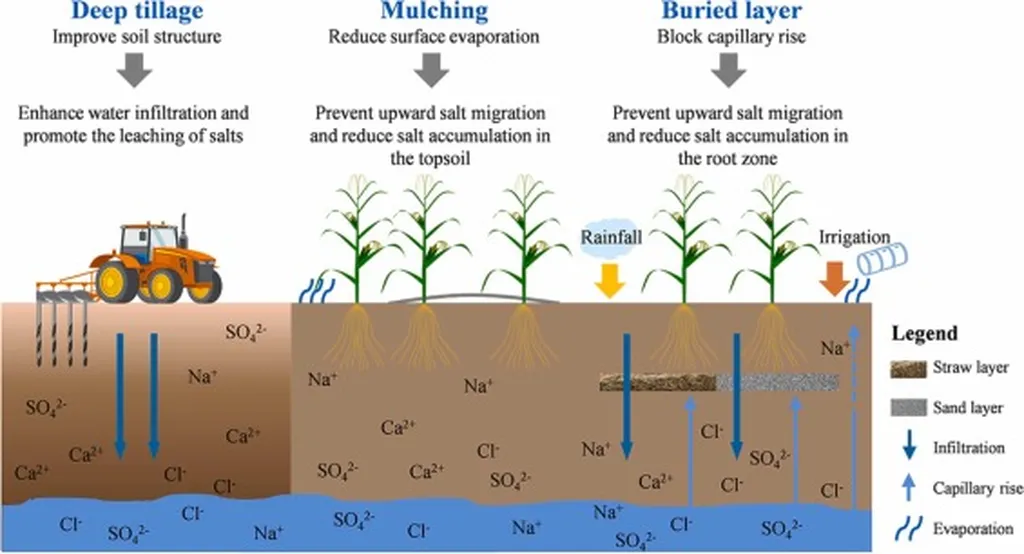
China’s fight to reclaim its saline-alkali soils—those stubborn, often barren lands where salt and alkali lock away nutrients and choke plant roots—is entering a new phase, according to a sweeping review published in *Agricultural Water Management*. The study, led by Qinghui Meng from Shanxi Agricultural University and the Chinese Academy of Sciences’ Institute of Soil Science, maps out how China is turning a national challenge into an opportunity, with implications that ripple far beyond farm fields and into energy, infrastructure, and climate resilience.
Saline-alkali soils cover an estimated 36 million hectares in China—land that could be vital for food security, carbon sequestration, and ecological restoration. But reclaiming it isn’t just about tilling the soil. “It’s about managing water, reshaping landscapes, and engineering ecosystems at multiple scales,” Meng and colleagues write. Their synthesis of over 8,400 research papers from 2006 to 2025 reveals how four distinct pathways—engineering, agronomic, amendment-based, and plant-based approaches—are converging into a unified strategy.
For the energy sector, this matters more than most realize. Reclaiming saline-alkali land often requires large-scale water infrastructure—pumps, drainage networks, groundwater regulation—that run on electricity or fossil fuels. As China expands renewable energy projects in arid and semi-arid regions, integrating soil reclamation with green energy systems could reduce operational costs and environmental footprints. For example, solar-powered desalination and drainage systems could simultaneously lower soil salinity and power irrigation, creating a closed-loop system that supports both agriculture and energy resilience.
Engineering measures are at the heart of this transformation. “We’re not just irrigating fields anymore,” said Meng in a recent interview. “We’re engineering the entire water-salt balance from the field to the watershed.” This includes subsurface drainage, controlled irrigation, and even groundwater pumping to draw down saline water tables. Such systems are energy-intensive, but when coupled with smart monitoring and AI-driven decision tools, they can optimize water use and reduce waste—a critical advantage in water-scarce regions where energy and water are tightly linked.
Agronomic practices, too, are evolving. By rebuilding soil structure and nutrient cycling, farmers can reduce reliance on chemical inputs, lowering both costs and carbon emissions. Meanwhile, amendment-based strategies—such as adding gypsum, biochar, or microbial inoculants—are being fine-tuned to work in specific hydrogeographic contexts. These aren’t just soil treatments; they’re precision interventions that could one day be powered by renewable microgrids in remote rural areas.
Perhaps most promising is the plant-based approach. Halophytes—salt-loving plants—and salt-tolerant crops like quinoa and barley are being deployed not just to stabilize soil, but to generate income. In coastal and inland saline zones, these crops could become part of bioenergy value chains, turning marginal land into productive assets without displacing food crops.
Looking ahead, the review calls for predictive, mechanism-based management—meaning real-time soil sensing, AI modeling, and adaptive policy frameworks. For the energy industry, this signals a growing market for integrated water-energy-soil management platforms, where data from sensors informs both irrigation schedules and energy dispatch.
Published in *Agricultural Water Management* (Nóngyě Shuǐlǐ Guǎnlǐ), the study doesn’t just summarize the past—it charts a course for scalable, green, and intelligent soil reclamation. In a nation where land is both a strategic asset and a constraint, the ability to turn saline deserts into productive landscapes could redefine China’s energy and agricultural future. And that’s not just good science—it’s a blueprint for resilience.