
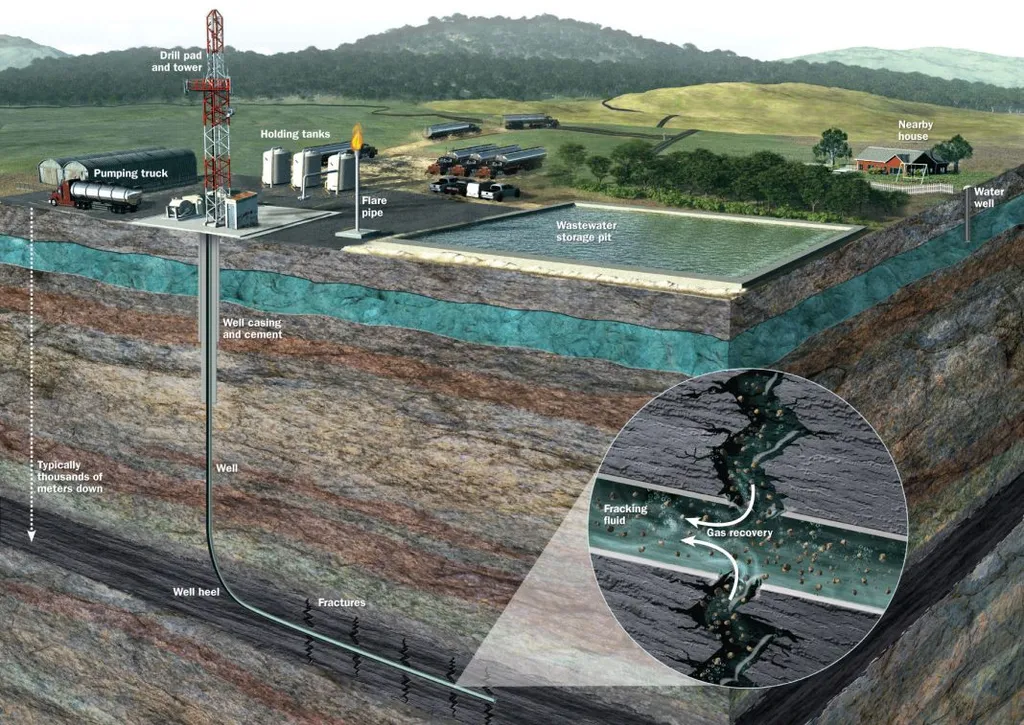
Deep underground, where the weight of the Earth presses down with crushing force, coal seams hold vast energy reserves—but also immense danger. For mining operators, the deeper they go, the greater the risk of catastrophic rockbursts and earthquakes triggered by stress and sudden fracture. A breakthrough study by Xin Zhang of the University of New South Wales, published in *Geohazard Mechanics* (formerly known as *地质灾害与防治学报*), offers new insight into how hydraulic fracturing—long used in oil and gas—can be adapted to manage these risks in deep coal mining.
Using a 150 mm cubic coal sample from a deep mine, Zhang and colleagues conducted a true tri-axial hydraulic fracturing experiment, simulating the complex stress environment found kilometers below the surface. They didn’t just watch cracks form—they listened to them. By recording acoustic emissions (AE), essentially the “sounds” of rock cracking under pressure, the team mapped the fracture’s birth, growth, and breakdown in unprecedented detail.
“What we observed wasn’t a smooth fracture front, but a dynamic, evolving network of micro-cracks,” Zhang explains. “The AE events tell us when and where the rock is about to fail—sometimes seconds before it happens.”
The data revealed three key stages: initiation, intersection, and breakdown. Water pressure rises, cracks form, and energy builds—until a sudden drop signals failure. But here’s the twist: the peak in crack activity (measured by AE events) often lags behind the peak water pressure. “This lag is due to dilatancy,” says Zhang. “The rock dilates, or expands, as micro-cracks open, absorbing energy before it’s released catastrophically.”
More surprising still, rapid pressure fluctuations triggered spikes in AE event rates—followed by eerie silence. “These quiet periods after bursts of activity could be early warning signs of impending fracture coalescence,” Zhang notes. In a real mine, such patterns could be detected using embedded sensors, allowing operators to adjust pressure or reinforce zones before disaster strikes.
The fractures didn’t follow a simple path either. At low pressure, cracks grew mostly along the direction of maximum stress—predictable, aligned, efficient. But at higher pressure, they spread out spherically, like cracks in a car windshield. “High pressure overcomes structural controls,” Zhang says. “The fracture plane becomes more chaotic, harder to model, and potentially more dangerous.”
Coal’s natural heterogeneity played a starring role. Instead of clean, planar fractures, the team observed tortuous, winding crack paths—like rivers carving through rock. “This means real-world fractures won’t match idealized models,” Zhang cautions. “Operators need to account for local weaknesses, cleats, and bedding planes.”
For the energy sector, this research points toward smarter, safer deep coal extraction. Hydraulic fracturing could be used not just to stimulate gas flow, but to *manage* stress—by pre-conditioning coal seams, releasing built-up strain gradually, and avoiding sudden failure. Mines could integrate AE monitoring with real-time pressure control, turning fracture “noise” into a predictive tool.
As Zhang puts it: “We’re not just fracturing coal—we’re listening to it. And that changes everything.”
Published in *Geohazard Mechanics* (地质灾害与防治学报), this work bridges rock mechanics, geophysics, and mining engineering. It suggests a future where deep coal mining isn’t just about digging deeper—but listening smarter, fracturing safer, and predicting with precision.