
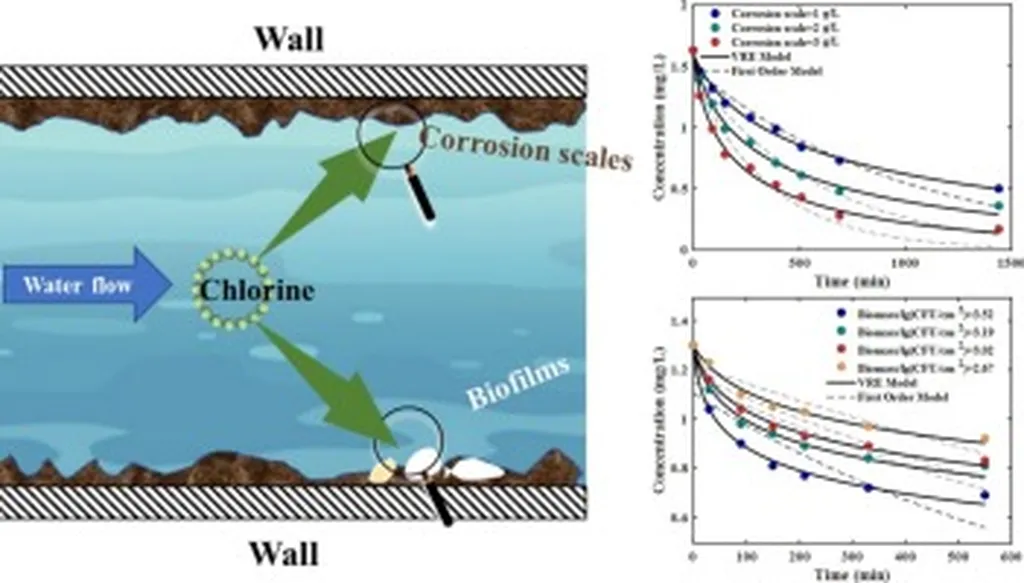
In the quiet hum of a water distribution system, something unexpected is unfolding. Shuai-Hua Hou and his team at Tongji University in Shanghai have uncovered a hidden dance between water flow and chlorine decay—a relationship so precise it could redefine how we manage water safety and energy efficiency in urban networks.
For decades, water utilities have relied on static models to predict chlorine levels in distribution systems. These models use fixed decay coefficients (k) to estimate how quickly chlorine dissipates over time. But as Hou’s research reveals, this approach might be missing a critical piece of the puzzle: the real-time interplay between flow variations and chlorine decay.
During a year-long field study in an instrumented closed-loop network, Hou and his team monitored chlorine residuals and flow rates with high-resolution precision. What they found was striking. Short-term fluctuations in flow rate (ΔQ) were tightly coupled with instantaneous changes in the chlorine decay coefficient (Δk). The relationship wasn’t just noticeable—it was linear, and it intensified during summer months when flow variability was highest. “We observed correlations approaching unity in some segments,” Hou noted, emphasizing how the system’s behavior became more dynamic under stress.
The implications are far-reaching. Utilities currently treat the chlorine decay coefficient as a fixed parameter, but this study suggests it should be modeled as a continuously varying state variable. Doing so could improve the accuracy of chlorine predictions, reduce the need for excessive chlorination, and ultimately lower energy costs associated with pumping and treatment.
Spatially, the study also uncovered a nuanced challenge. While individual pipe segments (AB, BC, CD) showed strong ΔQ – Δk correlations, the combined segment AC exhibited a weaker response due to the cancellation of opposing sub-segment effects. This highlights the complexity of real-world systems, where localized dynamics don’t always aggregate neatly.
For the energy sector, this research could be a game-changer. Water utilities are among the largest energy consumers in municipal infrastructure, and optimizing chlorine management could translate to significant savings. Imagine a system where utilities adjust dosing in real-time based on flow conditions, reducing waste and energy use without compromising safety.
Published in the *LHB Hydroscience Journal* (formerly *Lebensmittel-Wasser-Hygiene*), this work isn’t just another academic study—it’s a call to rethink how we model and manage water distribution. As cities grow and climate variability increases, the need for dynamic, responsive systems has never been clearer. Hou’s findings could be the first step toward smarter, more efficient water networks—where every drop and every molecule of chlorine is accounted for.