
The coconut groves of Sri Lanka, India, and the Philippines are quietly becoming the front line of a global battle against climate change—one that could ripple through the energy sector long before the next hurricane or drought hits. Tharindu D. Nuwarapaksha, a plant physiologist at the Coconut Research Institute in Lunuwila, has spent the last three years piecing together how rising temperatures, erratic rainfall, and coastal erosion are quietly rewriting the economics of coconut farming. In a new synthesis published in *Frontiers in Climate*, he and his team argue that the same technologies now optimizing oil palm and rubber plantations—remote sensing, drones, and soil-moisture sensors—can be repurposed to protect coconut palms, a crop that supports an estimated 10 million livelihoods across the tropics.
“Coconuts are the silent battery of rural economies,” Nuwarapaksha told us from his lab overlooking the Indian Ocean. “When yields drop, the first shock is felt by smallholders, but the second-order effects ripple into biofuel markets, coconut-water bottlers, and even the grids that power irrigation pumps.” His review shows that a single degree of warming can cut nut set by 12–15 %, while saltwater intrusion in coastal belts is already salinizing soils faster than palms can adapt.
The commercial hook for energy planners is clear: coconut plantations are increasingly tapped for co-generation. Coconut husks and shells are burned in biomass boilers to produce steam for turbines or biogas for local grids. When yields fall, the feedstock supply tightens, squeezing plant load factors and raising generation costs. Conversely, precision tools that let farmers irrigate only when palms show early water stress can stabilize both nut output and energy feedstock.
Nuwarapaksha’s team demonstrates how freely available Sentinel-2 imagery can flag canopy-temperature anomalies weeks before visible wilting, giving mill operators time to reroute husk contracts or switch to backup biomass sources. “We are turning a 50-year-old crop into a data stream,” he says. The same UAVs that scout for red palm weevil can also map evapotranspiration across 200-hectare blocks in under two hours—information that directly informs bioenergy feedstock contracts and hedge pricing.
What makes the work stand out is its insistence on low-cost integration. The Coconut Research Institute has already field-tested $200 LoRa soil probes linked to farmers’ smartphones, a price point that keeps the technology within reach of cooperatives that supply husks to nearby mini-grids. Nuwarapaksha argues that scaling these systems will require not just cheaper sensors but also policy bridges—carbon credits for climate-resilient plantations, for instance, or feed-in tariffs that reward steady biomass supply rather than peak production.
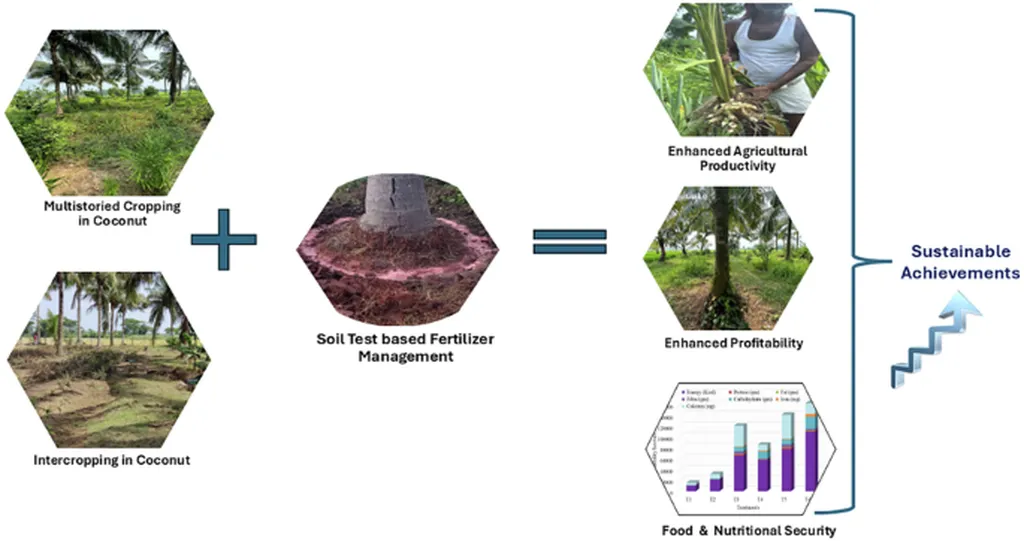
Looking ahead, the research flags three inflection points for the energy sector. First, AI-driven yield models trained on multi-spectral drone data could give grid operators probabilistic forecasts of husk availability, enabling hedging strategies months in advance. Second, salt-tolerant cultivars identified through genomic selection could secure coastal plantations that currently supply 30 % of Sri Lanka’s biomass power. Third, climate-smart agroforestry—intercropping coconuts with nitrogen-fixing legumes—boosts soil carbon while buffering palms against heat spikes, potentially qualifying for voluntary carbon markets that energy buyers increasingly use to offset scope 3 emissions.
For energy planners, the message is simple: the coconut belt is not just a source of volatile feedstock; it is a living laboratory for climate adaptation that directly impacts the reliability of renewable biomass power. Nuwarapaksha’s synthesis, published in *Frontiers in Climate*, offers a roadmap—one that turns a humble palm into a sentinel for both farmers and the grids they increasingly power.