
The debate over who should manage and finance water and sanitation systems—public authorities or private actors—has sharpened with a recent intervention from Public Services International (PSI). Its call to prioritise public water systems and public financing is not just ideological but backed by interim findings from a report by the Public Services Research Unit (PSIRU) at the University of Greenwich. This report scrutinises the policy recommendations of the Global Commission on the Economics of Water (GCEW), a think-tank launched in 2022 by the Dutch government and facilitated by the OECD, whose two-year mandate sought to rethink water economics and management. The PSIRU analysis argues that the GCEW’s proposals rely on repackaged neoliberal policies masquerading under new terminology, while systematically overlooking the proven track record of public utilities.
Public operations have long been the backbone of water and sanitation development globally. The PSIRU report highlights that excellence in service delivery often resides in the public sector, whether in high-income countries or developing nations. This includes reducing leakage, expanding coverage, renewing infrastructure, and ensuring democratic governance—all while reinvesting profits into the service rather than extracting them for shareholders. In Phnom Penh, Cambodia’s public utility PPWSA expanded service coverage from 50% in 1993 to 85% by 2004, largely in the last seven years of that period. Meanwhile, in Paris, after remunicipalising water in 2010, the public utility Eau de Paris cut tariffs by 8% while increasing investment, benefiting users—including the most disadvantaged—and the environment. It later won a UN Public Service Award for transparency and integrity. Contrast this with England, where 35 years of privatisation have seen utilities pay out £83 billion in dividends while underinvesting by up to 8% of approved expenditure, selling off 35 reservoirs, and contributing to over 3.6 million hours of raw sewage discharge in 2023. Public sentiment now overwhelmingly favours renationalisation.
Public utilities also have a unique capacity to engage in Public-Public Partnerships (PUPs)—collaborative, not-for-profit arrangements that share expertise and capacity without commercial pressures. The turnaround of PPWSA in Phnom Penh was significantly bolstered by a PUP with Brisbane Water in Australia. Another example is Kaunas, Lithuania, which, after partnering with Stockholm Vatten in the 1990s, built its first wastewater treatment plant. This improvement enabled Kaunas to secure a €14.7 million loan from the European Bank for Reconstruction and Development in 2001 without sovereign guarantees—a first for a Lithuanian utility. Yet despite these successes, PUPs remain underfunded relative to global needs, while international financial institutions continue to promote privatisation, public-private partnerships (PPPs), and blended finance—policies repeatedly shown to fail.
The GCEW’s final report, published in 2024 and promoted at major events like the UN 2023 Water Conference and COP30, frames its recommendations in the language of justice and human rights. But PSIRU researchers argue these are old policies in new packaging. The Commission proposes “Just Water Partnerships” built on blended finance, where public funds are used to de-risk private investment. Yet the World Bank estimates private sector participation in water spending in lower- and middle-income countries stands at just 1.7%, and a 2023 Water Integrity Network report found that water and sanitation accounted for less than 1.5% of commercial finance mobilised between 2017 and 2019—covering less than 2% of the funding gap. Similarly, the GCEW’s “Symbiotic Partnerships” concept effectively rebrands PPPs, despite their well-documented failures. PPPs in water services have led to de-privatisations worldwide, often because private companies extract excessive profits—visible in contracts guaranteeing returns as high as 22% in Jakarta or in the chronic underperformance of Thames Water in London.
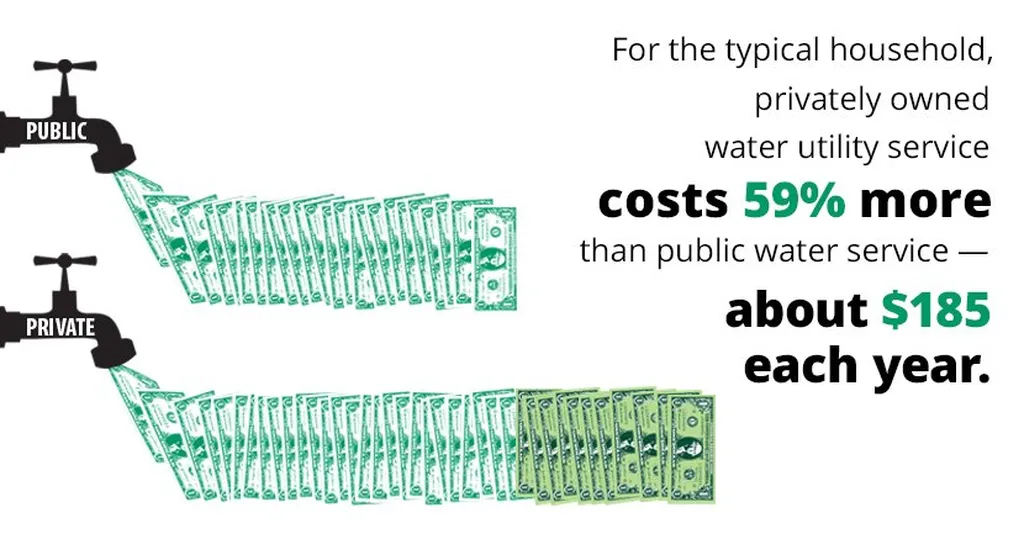
Private operators frequently resist regulation when it conflicts with profit margins. In Manila and Arezzo, private concessionaires suspended concession fee payments and threatened legal action when disputes arose. In Brussels, a private company halted operations at a wastewater treatment plant during a remuneration dispute, causing environmental damage. The GCEW also insists on “full cost recovery,” meaning prices must cover all costs without subsidies, allegedly to ensure remuneration for private financiers. But international experience shows this model harms users and taxpayers, undermines human rights to water and sanitation, and threatens sustainable development.
The human stakes are clear: water is not a commodity to be traded for profit but a common good requiring public stewardship. The