
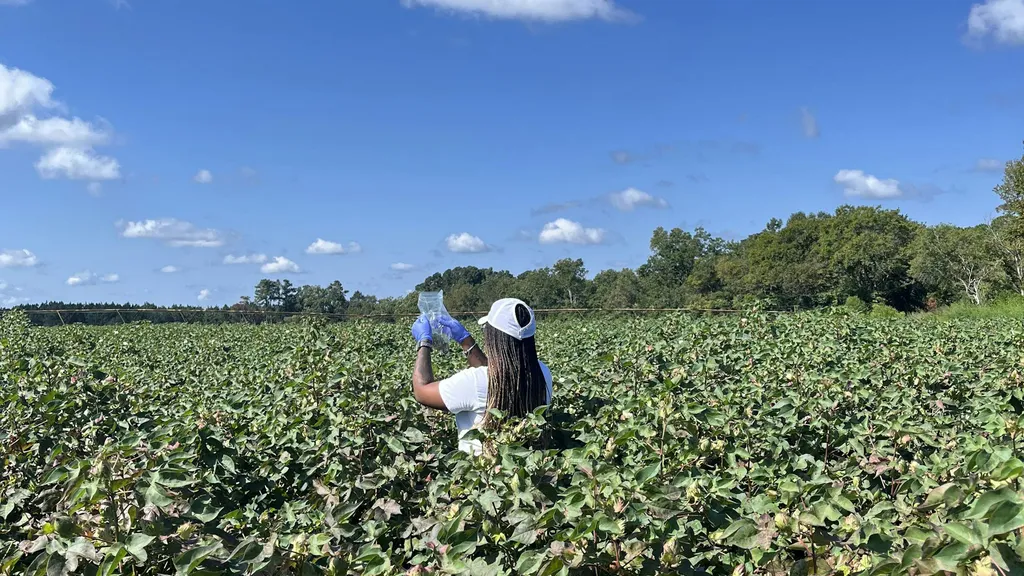
In the sun-scorched fields of northern China’s Hebei Province, where cotton thrives under the watchful eye of drip irrigation, a quiet revolution is taking shape—not in the soil itself, but in the leaves of the plants. Bo Gao, a researcher at the School of Water Conservancy and Hydroelectric Engineering at Hebei University of Engineering, has uncovered a way to peer into the hidden salt content of the earth using nothing more than a smartphone and a dash of machine learning.
The challenge is a familiar one across the globe: soil salinity. As drip irrigation systems spread—vital for water conservation in drought-prone regions—they can inadvertently introduce salts into the soil, gradually degrading land quality. Traditional methods of measuring electrical conductivity (EC), a proxy for salinity, require expensive equipment and lab analysis. But Gao’s team has shown that the answer might lie in the leaves of the cotton plants themselves.
By capturing high-resolution RGB images of cotton leaves with a standard smartphone, the researchers extracted two key pieces of information: color and texture. Color changes in leaves often signal stress from salinity, while texture—analyzed using advanced Gabor filters and gray-level co-occurrence matrices—reveals finer details about the plant’s health. These features were then fed into machine learning models, including Decision Trees and Random Forests, to predict soil EC.
The results were striking. “Fusing color and texture features significantly improved prediction accuracy,” Gao noted, highlighting how the Random Forest model, when trained on both types of data, outperformed simpler approaches. The RGB+TF model achieved an R² of 0.79 and an RMSE of 243.87 μS/cm—an 11% improvement over models using color alone. This isn’t just academic precision; it’s a practical leap forward for farmers and water managers.
For the energy sector, where water-intensive cooling and irrigation are common, this research could translate into smarter, more sustainable operations. Power plants and agricultural operations relying on drip irrigation could use this method to monitor soil health in real time, reducing the need for costly lab tests and enabling proactive adjustments to irrigation schedules. In regions where water scarcity and salinity are growing concerns, such tools could be game-changers.
Published in *Agricultural Water Management* (《农业水管理》), this study underscores a broader trend: the fusion of low-cost sensing, machine learning, and agronomic insight is opening new frontiers in precision agriculture. As Bo Gao and his team continue to refine their approach, the implications stretch beyond cotton fields—toward a future where salinity monitoring is as routine as checking a weather app.
For now, the message is clear: sometimes, the key to understanding the ground beneath us starts with the leaves above.