
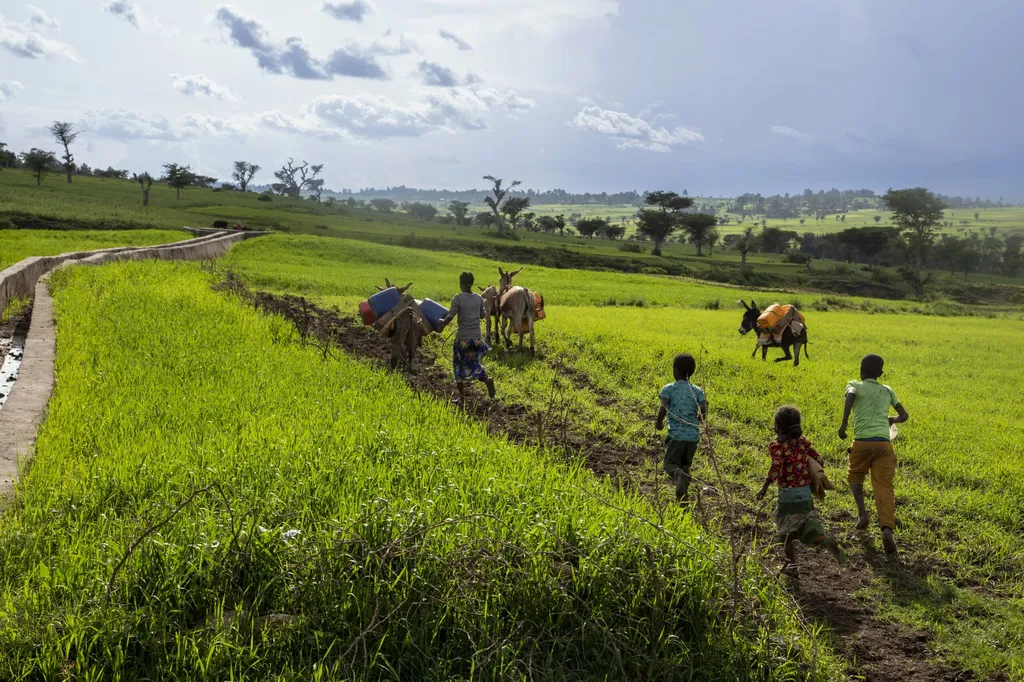
In the heart of Ethiopia’s Central Main Rift Valley Lakes Basin, a study led by Ashenafi Wondimu Teshale of Hawassa University’s Department of Hydraulics and Water Resources Engineering is quietly reshaping how we think about farming—and its hidden costs. The research, published in *Discover Environment* (formerly *Discovery Environment*), zeroes in on Boricha catchment, where soil loss from unsustainable agricultural practices isn’t just an environmental concern—it’s a looming challenge for energy and water security across the region.
For decades, farmers in Boricha have relied on conventional tillage, plowing fields to control weeds and prepare soil for planting. But this method, Teshale and his team found, comes at a steep price: increased runoff and soil erosion. “Conventional tillage accelerates soil degradation,” Teshale explains. “What we’re seeing is that it doesn’t just strip away fertile land—it also reduces water infiltration, which affects groundwater recharge and downstream availability.” That’s a critical issue in a region where water is not just life, but power.
Using a randomized complete block design in a split-plot experiment, the team tested nine combinations of tillage and cropping systems over two seasons (2024 and 2025). Their findings challenge long-held assumptions. “No tillage combined with maize and haricot bean intercropping emerged as a clear conservation winner,” says Teshale. “It cut runoff and soil loss significantly compared to conventional maize farming.” In practical terms, that means more water stays in the soil, less sediment chokes rivers and reservoirs, and farmland retains its productivity longer.
Why does this matter beyond the farm gate? Ethiopia’s energy sector, heavily reliant on hydropower, is acutely sensitive to sedimentation in its dams. The Grand Ethiopian Renaissance Dam (GERD) and smaller facilities across the basin depend on steady water flow and minimal siltation. Soil loss isn’t just dirt moving downhill—it’s a slow-motion crisis for turbines, irrigation canals, and water treatment plants.
Teshale’s work suggests that shifting to conservation tillage could be a low-cost, high-impact strategy to protect both soil and energy infrastructure. “Farmers don’t always see the link between how they till their land and the water flowing through turbines hundreds of kilometers away,” he notes. “But our data shows that soil health and water security are two sides of the same coin.”
The implications go beyond Ethiopia. Across sub-Saharan Africa, where smallholder farming dominates and climate change is intensifying rainfall variability, conservation practices like those tested in Boricha could become a cornerstone of climate-resilient agriculture. For energy planners, the message is clear: investing in sustainable land use isn’t just good for farmers—it’s a safeguard for the entire energy-water nexus.
As Teshale’s team continues monitoring trends into 2025, their work underscores a fundamental truth: the future of energy in water-scarce regions may be written not just in steel and concrete, but in the soil beneath our feet.