
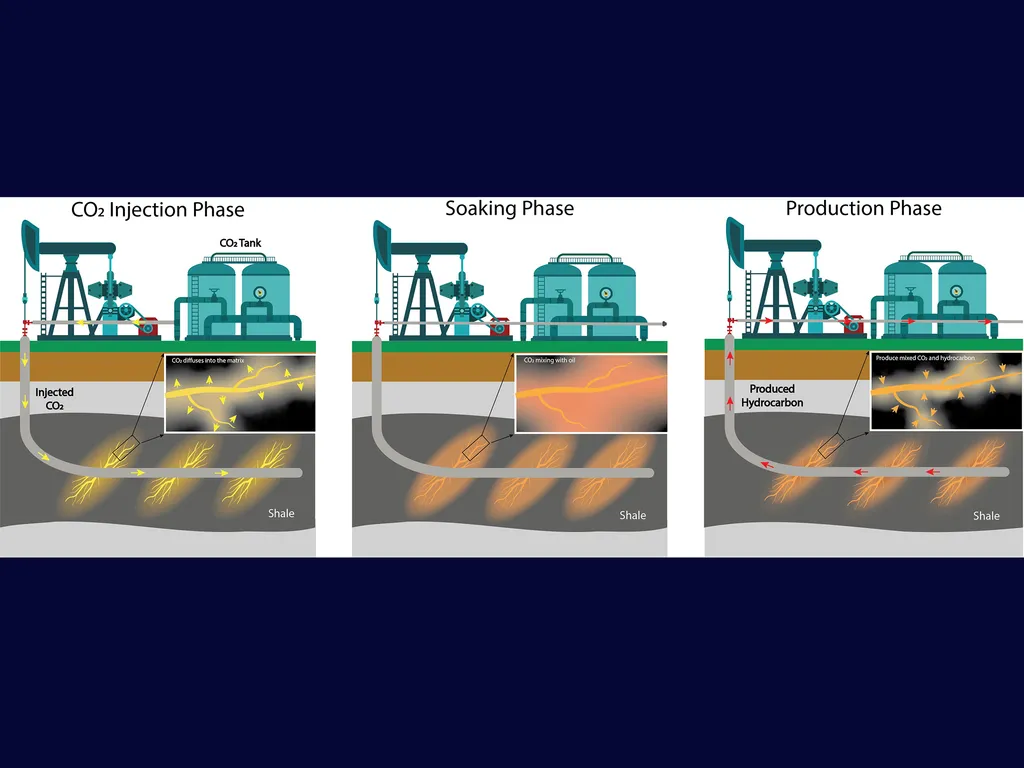
The race to meet global carbon reduction targets is pushing the energy sector into uncharted territory—particularly in shale reservoirs, where a promising yet understudied opportunity lies. A recent study published in *Duankuai youqitian* (translated as *Breaking Oil and Gas Fields*) by researchers led by LIU Weibin (State Key Laboratory of Continental Shale Oil, Daqing) and colleagues from the China Geological Survey and China University of Geosciences (Beijing) is shedding light on how carbon dioxide (CO₂) could be both stored and utilized in shale formations, offering a dual benefit for energy production and climate mitigation.
While CO₂-based enhanced oil recovery (EOR) is already a mature technology in conventional reservoirs, shale formations—with their vast, distributed resources and natural sealing capacity—are now emerging as a frontier for carbon storage and hydrocarbon extraction. The study highlights a key insight: CO₂ interacts with shale through multiple mechanisms, including mineralization, competitive adsorption, and crude oil dissolution. These interactions don’t just trap CO₂ underground; they also help mobilize trapped oil, potentially unlocking previously inaccessible resources.
“This isn’t just about burying carbon—it’s about turning an environmental challenge into an operational advantage,” says LIU Weibin. “Shale reservoirs have unique properties that could make them ideal for both storage and stimulation.”
The research underscores that while lab and simulation studies have advanced understanding, real-world deployment faces hurdles. Critical questions remain about how injection temperature, pressure, fluid composition, and operational methods influence CO₂ storage efficiency and oil mobilization. The team emphasizes the need for deeper investigation into CO₂-water-rock-hydrocarbon interactions across different shale types, as well as how pore structures evolve under CO₂ injection.
For energy companies, the implications are significant. If proven scalable, CO₂-EOR in shale could reduce carbon footprints while boosting production from mature fields. It aligns with the global push toward CCUS (carbon capture, utilization, and storage) and offers a pathway to monetize carbon while extending the life of oil assets.
Still, challenges loom. Regulatory frameworks, long-term storage integrity, and economic viability will determine whether this becomes a mainstream strategy. The study calls for a standardized, quantitative evaluation method—one that integrates multi-phase and multi-field dynamics—to assess both storage potential and oil recovery limits.
As the energy transition accelerates, shale reservoirs may well become a linchpin in the CCUS ecosystem. The work by LIU and his team isn’t just academic—it’s a blueprint for an industry at a crossroads, where innovation in carbon management could redefine the future of oil and gas.