
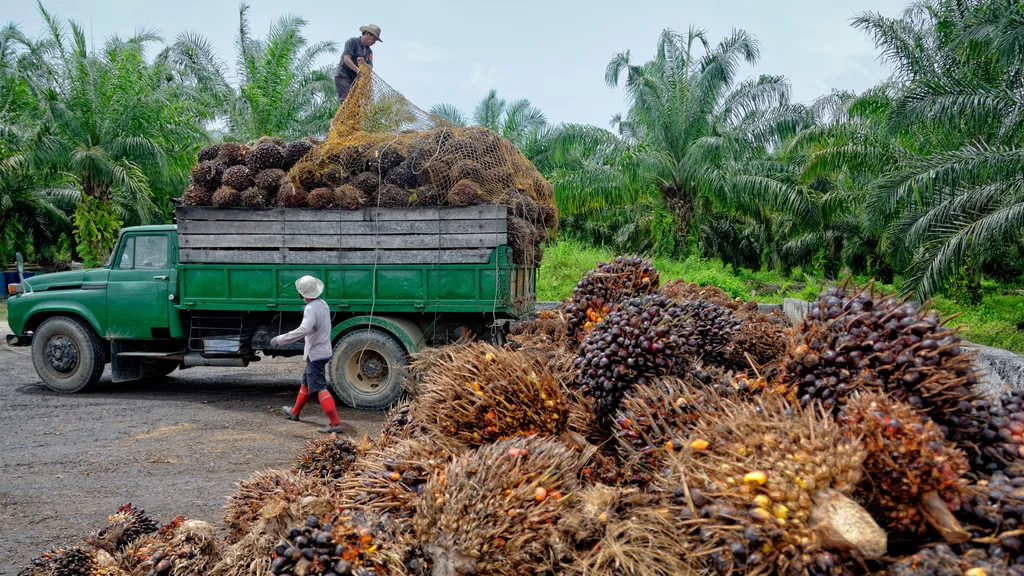
In a quiet corner of Indonesia’s petrochemical landscape, a team of researchers has quietly cracked open a door to a future where bioplastics could challenge the dominance of oil-based polymers. Led by Muhammad Zulfikar Luthfi at the Politeknik Industri Petrokimia Banten, the study published in *Journal of Technology and Agricultural Industrial Products* explores how waste from palm oil processing—specifically oil palm empty fruit bunches—can be transformed into a high-performance bioplastic using sago starch and nano-crystalline cellulose (NCC).
The breakthrough lies not just in repurposing agricultural waste, but in the precision of the formulation. Using Response Surface Methodology (RSM), the team optimized a blend of NCC derived from OPEFB and a dispersing agent to create a bioplastic that meets key food packaging standards. At just 5% NCC and 0.5% dispersing agent, the material achieved a tensile strength of 37.612 MPa and a water vapor transmission rate of 3.990 g/m²/day—numbers that put it in the same league as many conventional plastics.
“This isn’t just about making plastic from plants,” says Luthfi. “It’s about creating a material that can perform under real-world conditions—strong enough for packaging, resistant enough to moisture, and sustainable enough to reduce our reliance on fossil fuels.”
The implications ripple beyond the laboratory. Indonesia is one of the world’s largest palm oil producers, generating millions of tons of empty fruit bunch waste annually. Much of this ends up burned or landfilled, contributing to pollution and greenhouse gas emissions. By converting this biomass into high-value NCC for bioplastics, the industry could unlock a new revenue stream while cutting waste.
For the energy sector, the shift is subtle but significant. While bioplastics won’t replace petrochemicals overnight, their rise could reduce demand for virgin fossil-based polymers in packaging—a market worth hundreds of billions. More importantly, this research signals a pathway where agricultural residues become feedstock for advanced materials, aligning with circular economy goals and potentially lowering lifecycle emissions in plastic production.
The study, published in the *Journal of Technology and Agricultural Industrial Products* (formerly *Jurnal Teknologi & Industri Hasil Pertanian*), doesn’t claim to have solved the bioplastics challenge entirely. Commercial scale-up still faces hurdles in cost, processing speed, and regulatory acceptance. But it offers a data-driven roadmap for industries looking to transition toward renewable alternatives without sacrificing performance.
As global regulations tighten on single-use plastics and corporate sustainability pledges multiply, innovations like this one could serve as a bridge between today’s oil-dependent systems and tomorrow’s bio-based economy. And somewhere in Banten, a small polytechnic is quietly leading the charge.