
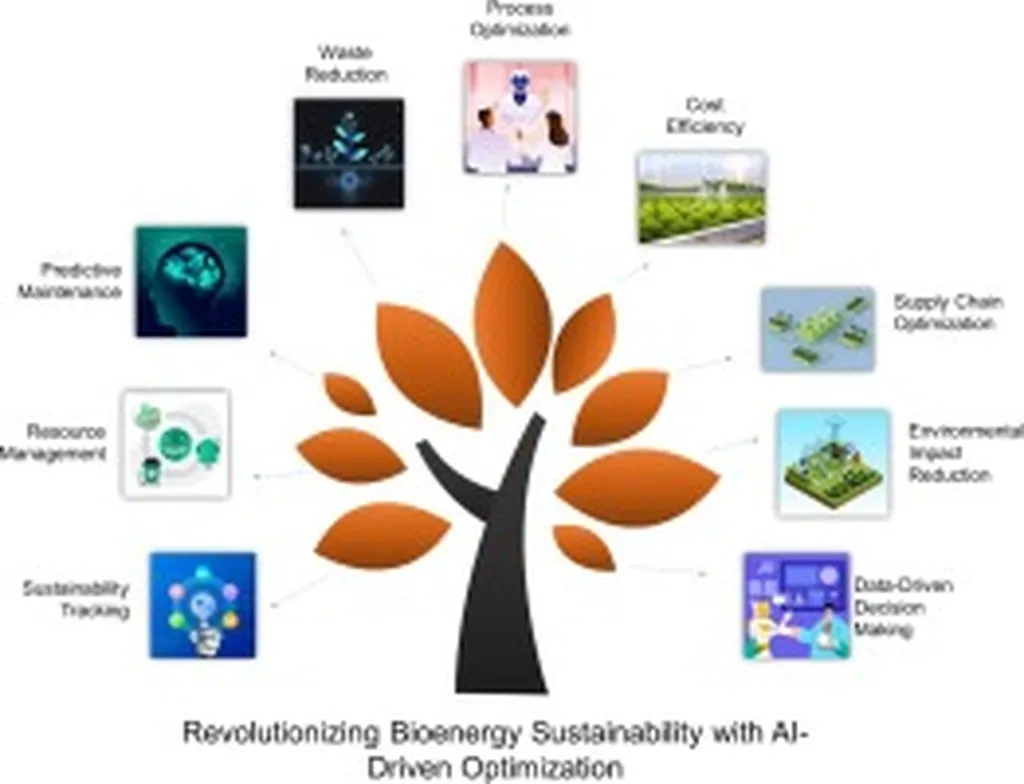
When Johanna Gonzalez, a researcher at North Carolina State University’s Department of Forest Biomaterials, set out to study how artificial intelligence could revolutionize the way biomass moves from forests to bioenergy plants, she wasn’t just solving a technical puzzle—she was addressing one of the biggest bottlenecks in the green energy transition.
Biomass—organic material like wood chips, agricultural residues, and energy crops—is a cornerstone of the circular economy, offering a renewable feedstock for everything from biofuels to bioplastics. But unlike oil or coal, biomass is bulky, perishable, and scattered across vast landscapes. Transporting it efficiently has long been a logistical nightmare. Gonzalez and her team found that the answer might lie in merging two powerful forces: multimodal transport and artificial intelligence.
Their research, published in the journal *Logistics*, reveals that AI-driven optimization can transform how biomass moves through the supply chain. “We’re not just talking about moving material from point A to point B,” Gonzalez explains. “We’re talking about a dynamic system where every decision—whether it’s routing, storage, or mode of transport—has to be made in real time to keep costs down and efficiency up.”
The study breaks new ground by mapping out a four-tiered framework: the physical constraints of biomass, mathematical models for multimodal networks, AI-powered decision-making, and strategic supply chain design. The results are striking. For short hauls, trucks remain the most practical option. But for long-distance transport, integrating rail and waterways—guided by AI—can slash both costs and carbon emissions. Machine learning models, for instance, can predict demand with far greater accuracy, optimize cargo loads, and reroute shipments on the fly to avoid delays or bottlenecks.
One of the most promising tools highlighted in the research is the digital twin—a virtual replica of the supply chain that lets operators simulate scenarios before they happen. “Imagine being able to test how a hurricane in the Southeast would disrupt your biomass deliveries,” Gonzalez says. “With a digital twin, you can run thousands of what-if simulations in minutes and adjust your strategy before a single truck leaves the yard.”
The commercial implications are hard to overstate. For energy companies and biofuel producers, this could mean lower feedstock costs, more reliable supply chains, and a clearer path to meeting sustainability targets. It could also make smaller, decentralized biomass processing facilities more viable, reducing the need for long-distance hauls altogether.
But the road to full implementation isn’t without hurdles. Data fragmentation—where information is siloed across different stakeholders—remains a major challenge. Gonzalez emphasizes that seamless coordination will require investment in digital infrastructure and standardized data-sharing protocols. “We can’t optimize what we can’t measure,” she notes. “And right now, too much of the biomass supply chain operates in the dark.”
As the energy sector races to decarbonize, innovations like AI-optimized logistics could be the difference between a supply chain that’s merely functional and one that’s truly transformative. For Gonzalez, the work is just beginning. “This isn’t just about moving biomass,” she says. “It’s about building a smarter, more resilient system for the entire bioeconomy.”