
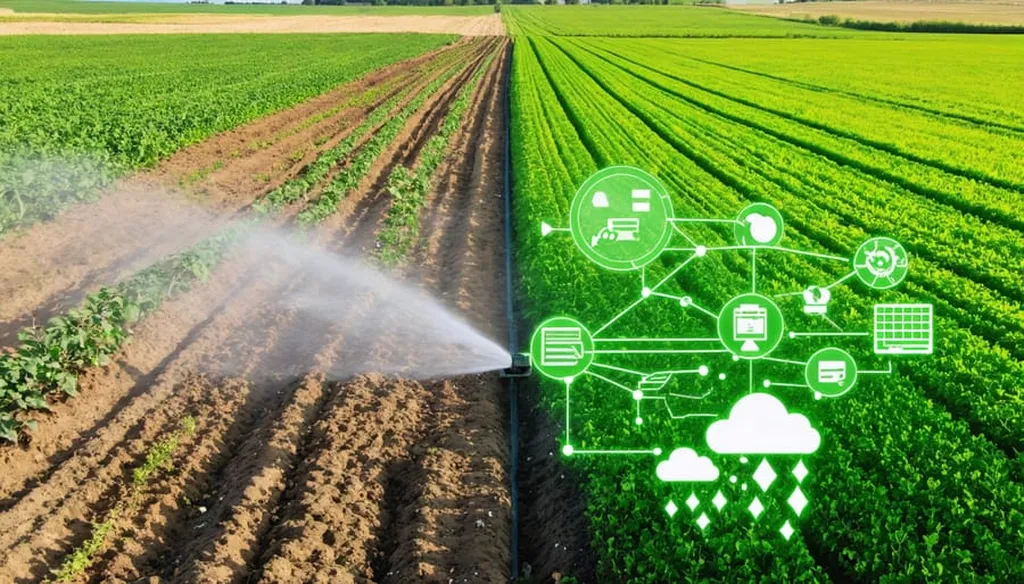
In the heart of Alberta’s irrigation belt, where fields stretch as far as the eye can see, a quiet revolution is underway. Farmers are turning to precision agriculture (PA), a suite of technologies designed to squeeze every drop of efficiency from their operations—without squeezing the environment dry. Dr. Lorraine A. Nicol, an economist at the University of Lethbridge, has just published a study in the *Journal of Rural and Community Development* (or *Journal of Rural and Community Development*, as it’s known in English) that peers into this shift, revealing how Alberta’s farmers are embracing these tools and what it could mean for the future of farming—and energy.
The study, which surveyed farmers in three key irrigation districts, found that adoption of PA isn’t uniform. Instead, it’s shaped by local conditions, farm size, and even the age and education of the farmers themselves. “We expected to see a clear pattern where younger, more educated farmers on larger operations would lead the charge,” Nicol explains. “But the reality is more nuanced. Each district has its own rhythm.”
Take, for example, the district where specialty crops like potatoes and vegetables dominate. Here, farmers are more likely to invest in advanced PA tools like soil moisture sensors and variable-rate technology, which tailors water and fertilizer application to the needs of each plant. In contrast, the district focused on grain production shows slower uptake, with farmers favoring simpler tools like GPS-guided tractors over high-tech systems.
What’s consistent across all three districts, though, is the bottom-line benefit: reduced inputs. Farmers reported using less irrigation water, fertilizer, herbicides, and pesticides thanks to PA. For an energy sector watching water and chemical use closely—especially in a province where agriculture is a major water consumer—this is no small thing. Less water drawn from rivers and aquifers means less energy spent pumping it. Fewer chemicals mean less energy used in their production and application.
The study also hints at a generational divide. Younger farmers, who grew up with smartphones and drones, are more comfortable adopting PA. But Nicol’s data suggests that even older farmers aren’t entirely left behind. “We found that experience and adaptability matter just as much as age,” she notes. “Some of the most innovative farmers are those who’ve been in the field for decades but are open to new ways of doing things.”
For the energy sector, the implications are clear. As PA spreads, the demand for energy-intensive inputs like synthetic fertilizers and pumped irrigation could decline. That’s a win for sustainability—and for the bottom line. But it also means the energy industry may need to pivot. Companies that supply water infrastructure, fertilizers, or even farm equipment could see shifts in demand. Those that adapt—by developing energy-efficient irrigation systems or low-impact fertilizers—might find new opportunities in a changing market.
The study doesn’t claim PA is a silver bullet. Adoption varies, and not all farmers are rushing to embrace it. But as Nicol’s work shows, the trend is undeniable. In Alberta’s fields, the future of farming isn’t just about bigger harvests—it’s about smarter ones. And for the energy sector, that could mean rethinking how it fits into the equation.