
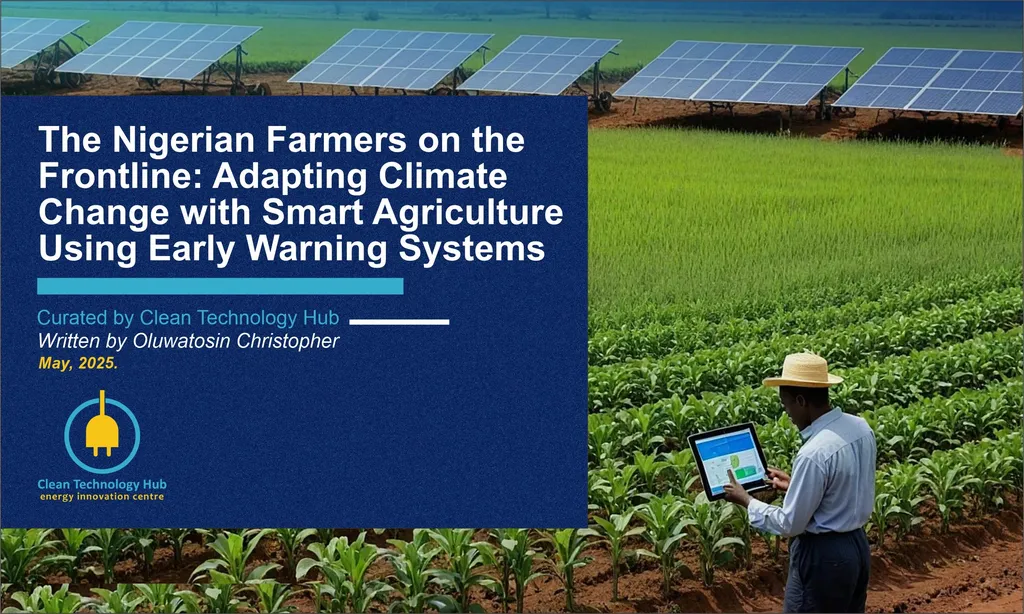
In the heart of Nigeria’s North Central region, where agriculture remains the backbone of rural livelihoods, farmers are quietly waging a battle against an invisible but relentless foe: climate change. A groundbreaking study led by Mercy Abutsa of Cornell University in New York reveals how these farmers are not just surviving but adapting—using a blend of age-old wisdom and innovative strategies to safeguard their future. Published in the *Journal of Rural and Community Development* (known in French as the *Revue du Développement Rural et Communautaire*), the research offers a rare glimpse into the resilience of smallholder farmers in the face of shifting weather patterns.
Abutsa’s team employed participatory action research (PAR), a method that places farmers at the center of the solution. Rather than imposing external fixes, the study sought to document and amplify the strategies already in use. “Farmers here have been reading the land like a book for generations,” Abutsa explains. “They don’t need a weather app to tell them when the rains will come—they watch the birds, the flowering of trees, the behavior of insects. That knowledge is gold.”
Among the six adaptation strategies identified, traditional ecological knowledge stood out as a cornerstone. Farmers in states like Benue and Plateau rely on natural indicators—such as the arrival of the *madjankala* (a local sparrow) or the flowering of the *mimosa* tree—to predict rainfall. These signs, passed down through generations, now serve as early warning systems in an era of unpredictable weather. But adaptation goes beyond observation. The study highlights how farmers are also turning to irrigation and dry-season farming to cushion the blow of erratic rains. For example, the use of solar-powered drip irrigation systems is gaining traction, allowing crops to thrive even when monsoons fail.
Another key finding is the shift toward improved seedlings and greenhouse farming. Hybrid seeds resistant to drought or pests are becoming more accessible, while small-scale greenhouses—often built with locally available materials—are extending growing seasons. “It’s not about reinventing the wheel,” Abutsa notes. “It’s about giving farmers the tools to turn their ancestral knowledge into actionable resilience.”
For the energy sector, these insights could spark new opportunities. Solar-powered irrigation, for instance, aligns with Nigeria’s push toward renewable energy and decentralized power solutions. Companies investing in off-grid solar for agriculture could find a ready market in North Central Nigeria, where farmers are eager to reduce reliance on unpredictable rainfall—and, by extension, the national grid. The demand for climate-smart technologies could also drive partnerships between agribusinesses, energy providers, and local cooperatives.
Yet the study cautions that these adaptations won’t scale without support. Farmers need access to financing, training, and markets to sustain their efforts. “The biggest challenge isn’t the lack of ideas—it’s the lack of infrastructure to turn those ideas into reality,” Abutsa says. “If we want to see these strategies flourish, we need to listen to the farmers first.”
The implications ripple beyond Nigeria’s borders. As climate change tightens its grip on agriculture worldwide, the lessons from North Central Nigeria—where tradition meets innovation—could offer a blueprint for other regions. For energy companies, this means rethinking how they engage with rural communities. Instead of top-down solutions, the future may lie in co-creation, where farmers’ insights guide the deployment of technology.
One thing is clear: the fight against climate change won’t be won with megaprojects alone. Sometimes, the most powerful solutions are the ones already growing in the soil—or flying overhead.