
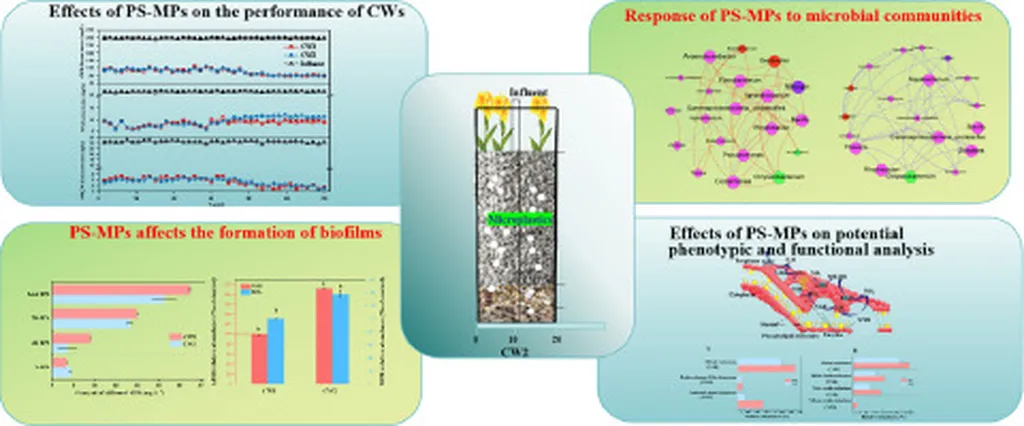
The invisible threat of polystyrene microplastics (PS-MPs) is quietly undermining one of the most critical pillars of modern wastewater treatment—biological nutrient removal. A new study led by Shengyuan Wang from the College of Environment and Energy Resources at Inner Mongolia University of Science and Technology reveals how these tiny plastic particles disrupt the delicate balance of microbial communities in anaerobic–anoxic–oxic (AAO) systems, the workhorse of advanced wastewater treatment plants.
In lab-scale experiments, Wang and his team exposed AAO reactors to varying concentrations of PS-MPs—10, 100, and 200 mg/L—and observed a clear dose-dependent decline in nutrient removal efficiency. Nitrogen removal dropped by up to 17%, while phosphorus removal fell by 5%. The culprit? A systematic disruption of the microbial communities and functional genes responsible for breaking down these nutrients. Key players like *Candidatus Accumulibacter*, *Dokdonella*, *Thauera*, and *Nitrospira*—microbes essential for nutrient cycling—saw their populations shrink, while the expression of critical nitrogen-cycle genes (amoA, amoB, amoC, nxrA, nxrB, narG, narH, narI) and phosphorus-cycle genes (ppk1, ppx) was suppressed.
“This isn’t just about microbial shifts—it’s about the genetic machinery failing at a molecular level,” Wang explains. “When these functional genes are downregulated, the entire nutrient removal process stalls, leading to higher effluent concentrations of nitrate and ammonium.”
The implications are far-reaching, particularly for energy-intensive wastewater treatment plants that rely on AAO systems to meet stringent discharge regulations. With PS-MPs ubiquitous in sewage, their interference with biological processes could force operators to reconsider treatment strategies, potentially increasing energy consumption to compensate for reduced nutrient removal efficiency. For industries dependent on water reuse or facing tightening environmental regulations, this research underscores an urgent need for long-term monitoring and mitigation.
Published in *Emerging Contaminants* (or *新兴污染物* in Chinese), the study adds to a growing body of evidence that microplastics are not just an environmental pollutant but a direct threat to the reliability of water infrastructure. As urban water security becomes increasingly strained, the findings suggest that the energy sector—particularly wastewater utilities—may need to invest in advanced filtration, microbial resilience strategies, or even alternative treatment processes to counteract this hidden disruptor.
The question now is whether the industry will act before the problem escalates—or wait until the cracks in the system become too costly to ignore.