
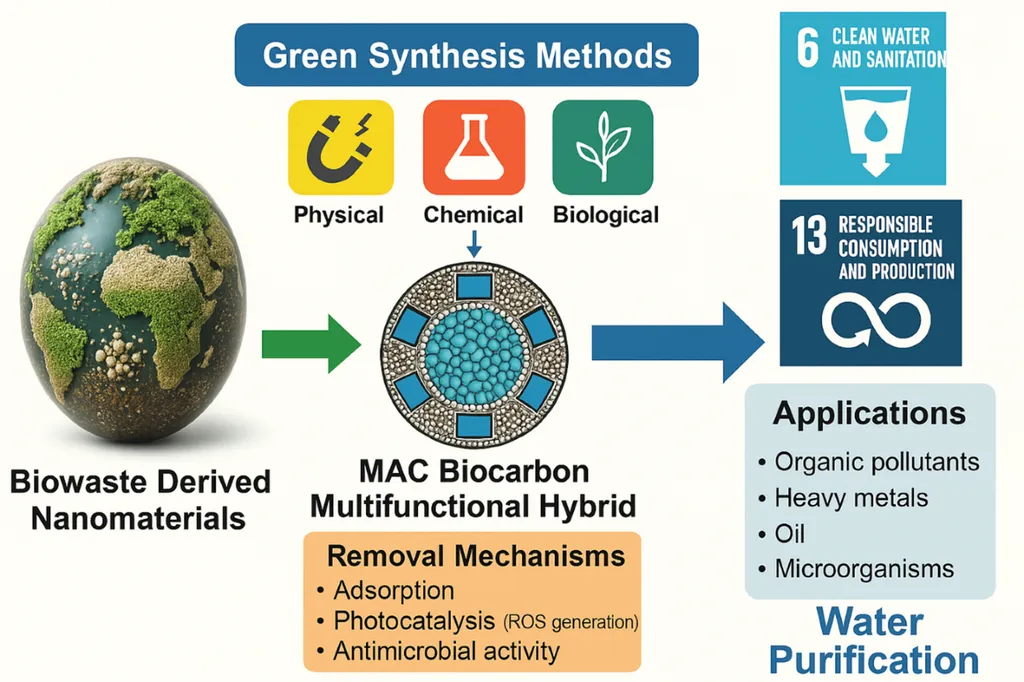
In a world where water scarcity and pollution are escalating, a groundbreaking review by Mushabe David, a researcher at Kampala International UniversityWestern Campus’s Department of Mechanical Engineering, is turning heads—not just in academic circles, but in boardrooms and energy sector discussions alike. The study, published in *Discover Applied Sciences* (translated from Chinese as *Kēxué Yìngyòng Fāxiàn*), presents a compelling case for transforming agricultural and industrial biowaste into high-performance nanomaterials for water purification, offering a sustainable alternative to traditional energy-intensive methods.
The research hinges on a critical insight: the very waste that burdens landfills and pollutes ecosystems could become the backbone of next-generation water treatment technologies. “We’re not just repurposing waste,” Mushabe explains. “We’re redefining how we approach water purification by leveraging the intrinsic properties of biowaste-derived nanomaterials.” His team’s analysis reveals that by carefully controlling activation processes—using chemicals like potassium hydroxide (KOH) or zinc chloride (ZnCl₂)—these materials can achieve a balance of adsorption, photocatalysis, and even antimicrobial functions, all while minimizing environmental harm.
What makes this work particularly intriguing for the energy sector is its potential to disrupt the status quo. Traditional water treatment relies heavily on energy-intensive processes, from reverse osmosis to advanced oxidation, which demand significant power inputs. Biowaste-derived nanomaterials, however, offer a lower-energy pathway. “The beauty of this approach is that it aligns with circular economy principles,” Mushabe notes. “We’re not only reducing waste but also cutting the carbon footprint of water treatment by using locally available feedstocks, which can be transformed into functional materials with minimal processing.”
The study also underscores a pragmatic trade-off: while engineered materials like metal-organic frameworks or graphene-based composites may outperform biowaste-derived alternatives in lab settings, the latter’s scalability, regeneration potential, and environmental compatibility make them a more viable option for real-world applications. This is especially relevant for decentralized water treatment systems, which are gaining traction in remote or off-grid locations where traditional infrastructure is impractical.
Yet, challenges remain. Feedstock variability, high activation energy requirements, and concerns about long-term stability are hurdles that researchers must overcome. Mushabe’s team emphasizes the need for standardized synthesis methods and predictive modeling to ensure consistency and performance. “We’re still in the early stages,” he admits. “But the trajectory is clear: biowaste-derived nanomaterials could become a cornerstone of sustainable water treatment, particularly in regions where energy resources are constrained.”
For the energy sector, this research signals a shift in priorities. As utilities and industrial players seek to reduce their environmental footprint, the integration of biowaste-derived solutions into water treatment processes could offer a dual benefit: lowering operational costs while enhancing sustainability credentials. Imagine power plants or manufacturing facilities not only consuming less water but also producing less waste—all while contributing to a circular economy.
The implications extend beyond individual facilities. Governments and municipalities grappling with aging infrastructure and tightening environmental regulations may find in this research a blueprint for future-proofing their water treatment strategies. By investing in biowaste valorization, they could simultaneously address waste management, energy efficiency, and water security—three of the most pressing challenges of our time.
As the field evolves, the next frontier will likely focus on refining these materials for specific applications, from heavy metal removal to pharmaceutical residue degradation. Mushabe’s work is a reminder that innovation often lies not in creating entirely new materials, but in reimagining what we discard. In the quest for sustainable water purification, the answer might just be blowing in the wind—or, more accurately, rotting in the compost heap.