
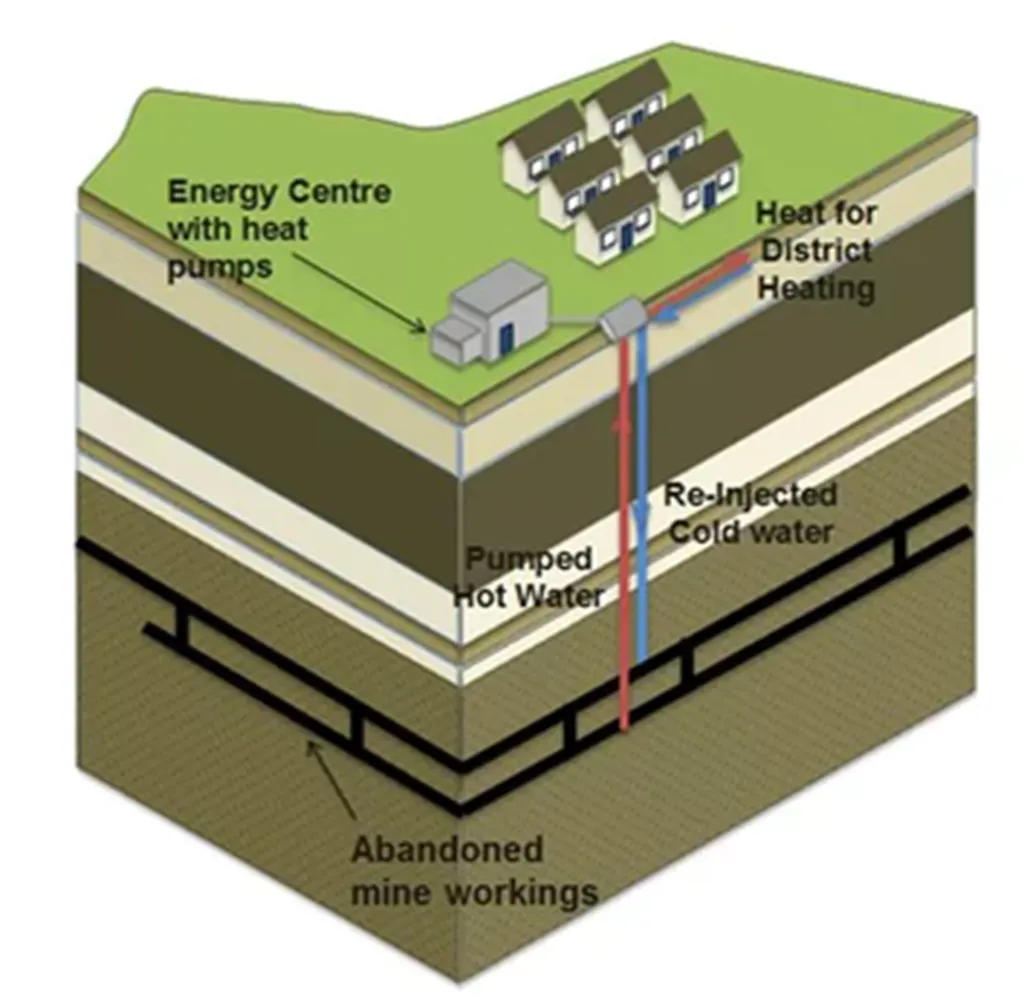
Dan Ma and his team at the Key Laboratory of Deep Coal Resource Mining in Xuzhou have uncovered a promising pathway to address two critical challenges in the energy sector: harnessing geothermal energy from coal mines while ensuring structural stability. Their review, published in *Meitan xuebao* (Journal of the China Coal Society), synthesizes recent advances in geothermal extraction and rock mass control, offering a framework that could redefine how coal mines operate as dual-purpose energy and resource hubs.
The research hinges on a counterintuitive insight: the very disturbances caused by mining—cracks, voids, and altered stress fields—can be repurposed to enhance geothermal efficiency. “We’re not just avoiding the damage mining causes,” Ma explains. “We’re turning it into an advantage.” The team’s work highlights techniques like *backfilling heat extraction*, where mine waste is used to store and transfer heat, and *water-conducting structure heat extraction*, which leverages fractures to circulate geothermal fluids. These methods could significantly reduce the capital costs of geothermal projects by leveraging existing infrastructure.
Yet the stability of these systems remains a delicate balance. Mining-induced stress, hydro-erosion, and thermal cycling can destabilize rock masses, risking water inrush or pillar failure. Ma’s group proposes innovative solutions, such as *hydrophobic high-strength grouting* and *superhydrophobic nano-grouting materials*, designed to withstand the harsh conditions of deep mines. “It’s like giving the rock a raincoat,” Ma quips, “but one that also reinforces it against mechanical and thermal stress.”
For the energy sector, the commercial implications are substantial. Coal mines worldwide are facing declining profitability and mounting pressure to decarbonize. By co-developing geothermal resources, operators could diversify revenue streams while supporting local energy needs. The International Energy Agency estimates that geothermal energy could supply up to 3.5% of global electricity demand by 2050—if extraction technologies become more accessible. Ma’s research suggests coal mines could play a pivotal role in this transition, particularly in regions with legacy mining infrastructure.
Still, challenges persist. The team notes gaps in large-scale validation and the need for more robust multi-field coupling models that account for mining-induced stress. Future work will require closer collaboration between academia and industry to translate these findings into real-world applications. As Ma puts it: “We’ve laid the groundwork, but the proof is in the pumping.”
For policymakers and investors, the message is clear: the fusion of coal mining and geothermal energy isn’t just feasible—it’s an opportunity waiting to be seized. And in the race to decarbonize, every heat source counts.