
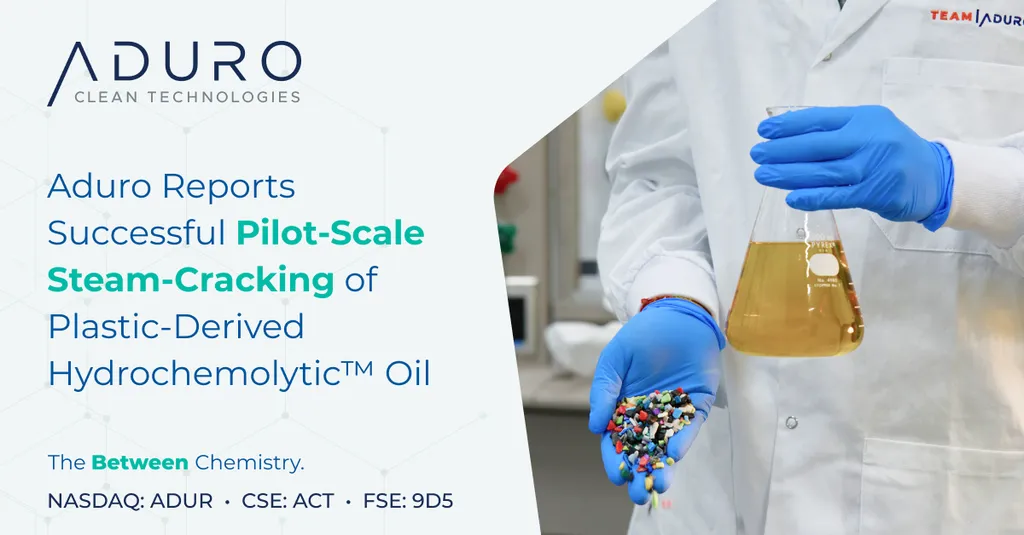
Aduro Clean Technologies is sharpening its commercial pitch this month as it moves from pilot-scale experiments to industrial deployment, with CEO Ofer Vicus scheduled to present at three investor conferences in April. The company’s Hydrochemolytic™ platform, which relies on water to chemically break down waste plastics, heavy bitumen, and renewable oils at relatively low temperatures and cost, is positioned as a bridge between pilot curiosity and large-scale resource recovery. The forums—Lytham Partners’ Industrials & Basic Materials Summit, the Gabelli Waste & Sustainability Symposium, and the WTR Insights Conference—aren’t generic networking stops; they’re curated stages where Aduro’s narrative will be tested against investors who fund scale-ups and operators who implement circular economy solutions.
At the Lytham summit, the focus will be on execution rather than technology alone. Management plans to detail how pilot campaigns are informing the design of the first commercial facility, emphasizing downstream validation and partner engagement as critical milestones. “We’re no longer just proving the chemistry works,” Vicus told investors earlier this year. “We’re showing how it integrates into existing infrastructure and supply chains.” That shift from lab to logistics matters in an environment where capital allocators demand evidence of de-risked pathways before committing to multi-hundred-million-dollar plants.
The Gabelli symposium zeroes in on waste and circularity, fields where hard-to-recycle plastics and mixed feedstocks remain the industry’s Gordian knot. Aduro’s return to the event signals sustained interest from a niche audience that evaluates solutions for complex waste streams. The company’s Hydrochemolytic™ Technology is framed as a way to process contaminated or laminated plastics that traditional mechanical recycling rejects, but the real question isn’t whether the chemistry can handle these streams—it’s whether municipalities and brand owners will adopt a process that requires water at scale and redefines their recycling economics. “The technology works, but the system has to change,” noted a circular-economy analyst at the 2025 Plastics Recycling Conference. “If Aduro’s process needs less preprocessing, that changes the cost curve for recyclers operating at thin margins.”
The WTR Insights Conference offers the deepest dive yet, with Water Tower Research providing a platform for granular discussion on pilot progress, validation timelines, and commercialization roadmaps. Investors here will scrutinize the company’s partner-driven approach, particularly how downstream validators—petrochemical firms, fuel blenders, or polymer producers—are aligning their specifications with Aduro’s output. The absence of a single dominant offtake partner in the near term could either temper enthusiasm or force Aduro to accelerate its market-building efforts.
Behind the conference circuit lies a strategic pivot: Aduro is recasting itself from a technology licensor to a project developer with skin in the game. The pilot plant’s operating campaigns are generating data not just on yields and energy use, but on operability, maintenance cycles, and integration with existing utilities. That operational intelligence will underpin the First-of-a-Kind (FOAK) facility’s design, where capital efficiency and reliability will determine whether lenders classify the project as bankable or speculative. “The jump from 10 to 100 tonnes per day isn’t linear in capital terms,” said an engineer who worked on a similar scale-up for a European pyrolysis venture. “You either pay now to learn in the pilot, or you pay later with costly retrofits.”
The company’s messaging also hints at regulatory tailwinds, particularly in jurisdictions tightening rules on plastic content and carbon intensity. Hydrochemolytic™’s water-based process could align with upcoming Extended Producer Responsibility (EPR) schemes that reward high-recovery technologies, but only if regulators recognize the outputs as bona fide recycled content. The burden of proof falls on Aduro to demonstrate that its oil-equivalents meet the same specifications as virgin feedstocks—a non-trivial task when fuel buyers demand consistency and refiners resist process variability.
Aduro’s investor outreach arrives at a moment when the clean-tech capital market is bifurcated. Growth-stage funds are still deploying dry powder, but due diligence cycles have lengthened, and generalist investors remain wary of execution risk. For the company, the conferences serve as both validation and pressure test: each Q&A will probe not just the technical upside, but the team’s ability to manage capital allocation, regulatory relationships, and market education simultaneously.
The forward-looking statements in the release underscore the gap between ambition and outcome. Management expects to update on pilot progress and commercialization pathways, but the industry has seen too many “next-gen” recycling ventures stall when pilot data fails to scale or offtake agreements evaporate. The question isn’t whether Aduro can process waste plastics—it’s whether the economics of doing so at industrial scale will outperform mechanical recycling, pyrolysis