
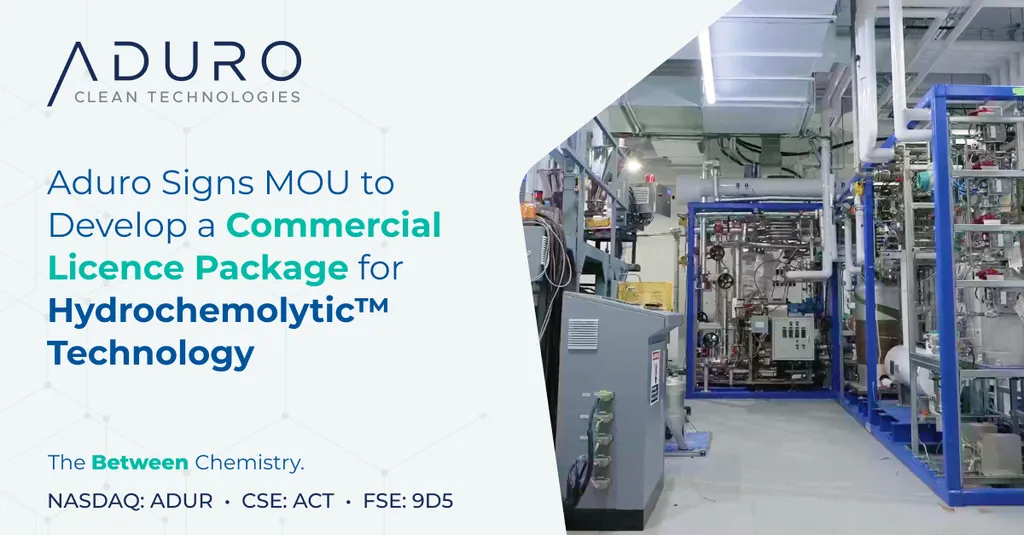
The shift from pilot-scale operations to industrial deployment is no small feat for a cleantech company—but Aduro Clean Technologies is positioning itself at the heart of that transition. CEO Ofer Vicus will present at three investor conferences in April, each offering a distinct lens on the company’s commercial momentum. At the Lytham Partners Industrials & Basic Materials Investor Summit, the focus will be on execution: how Aduro is moving beyond technology development to full-scale deployment, with updates on pilot plant performance and its strategy for securing industrial partners. “We’re not just talking about technology anymore,” Vicus said in a prepared statement. “We’re demonstrating a pathway from pilot to plant, and that changes the conversation with investors.”
The Gabelli Waste & Sustainability Symposium provides a more specialized audience—one deeply engaged in circular economy solutions. Here, Aduro is expected to emphasize the role of its Hydrochemolytic™ Technology in processing mixed and hard-to-recycle plastics. The challenge isn’t just breaking down waste streams; it’s integrating into existing recycling infrastructure while navigating regulatory hurdles. “The real test isn’t just whether the technology works in the lab,” Vicus noted. “It’s whether it can plug into today’s systems tomorrow—and do so at scale.” The symposium’s attendees, many of whom represent waste management firms, will likely scrutinize how Aduro’s approach aligns with current operational realities.
Meanwhile, the WTR Insights Conference offers a platform for deeper investor dialogue, particularly those seeking granular insights into growth strategies. Aduro’s participation here follows prior engagement with Water Tower Research, signaling a deliberate effort to refine its narrative around commercial validation. The emphasis will be on pilot-scale progress, downstream partnerships, and a structured roadmap to deployment. “Investors want to see de-risked pathways,” Vicus said. “Our pilot campaigns aren’t just technical milestones—they’re proof points that the model works.”
Aduro’s Hydrochemolytic™ Technology hinges on water as a catalyst at relatively low temperatures, a departure from traditional high-energy processes. The company argues this positions it to economically convert low-value feedstocks—from plastic waste to heavy bitumen—into higher-value outputs. But the leap from pilot to industrial scale is where many cleantech ventures stumble. Aduro’s upcoming presentations will need to address not just the technical feasibility but the commercial pragmatism: How will it secure offtake agreements? What partnerships are in place to validate end products? And crucially, how will it navigate the cost pressures of scaling a novel process?
The investor roadshow arrives amid growing scrutiny over the viability of chemical recycling. Critics argue that without clear pathways to large-scale adoption, such technologies risk becoming stranded assets. Aduro’s challenge is to counter that skepticism with tangible progress. The pilot plant’s operating campaigns, for instance, will need to demonstrate consistent output quality and cost efficiency—data points that could sway potential partners and financiers.
For the waste management sector, Aduro’s technology could offer a lifeline for hard-to-recycle plastics, a persistent pain point in circular economy models. Yet integration won’t be seamless. Municipal systems and private recyclers operate on tight margins, and retrofitting facilities to accommodate new processes requires both capital and conviction. Aduro’s ability to align with these stakeholders—through validation, education, and flexible partnerships—will determine whether its technology moves from niche solution to industry staple.
The coming months will test whether Aduro can translate investor interest into tangible traction. The conferences in April are a proving ground not just for its technology, but for its business model. As Vicus prepares to address these audiences, the question hanging in the air is whether Aduro is ready to take its place in the next generation of industrial infrastructure—or if it will remain a promising pilot in the wings.