
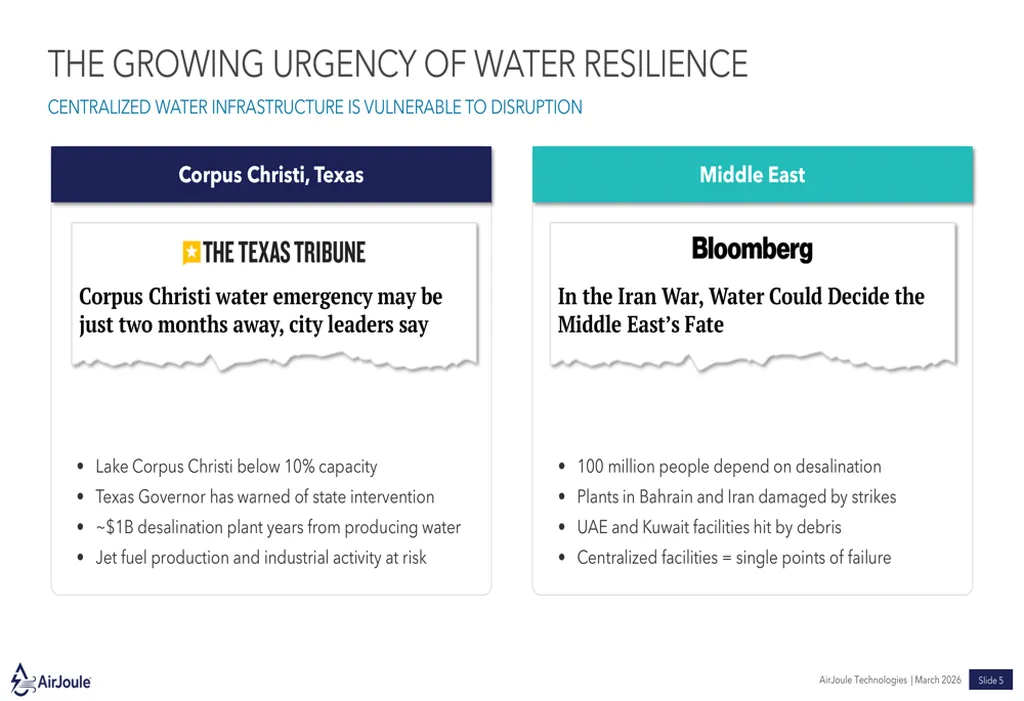
Management’s characterization of 2025 as a foundational year is more than rhetorical positioning—it reflects a deliberate pivot from efficiency metrics to resilience as a core value proposition. The shift isn’t abstract; it’s rooted in real-world constraints. “We’re moving from ‘sustainable desalination’ to ‘resilient, decentralized generation’ because centralized systems are now exposed,” a company spokesperson said. The validation phase across Texas, Arizona, and Dubai isn’t just testing performance in arid climates—it’s stress-testing the assumption that large-scale desalination remains viable when geopolitical disruption and extreme drought converge.
At the center of this strategy is the A250 Core platform, which began as a proof-of-value surrogate but has since become the technical anchor for derisking the larger Prime industrial system. By treating Core as a controlled environment for iterative failure, the company is compressing the feedback loop between engineering refinement and market readiness. “The Core wasn’t designed to scale—it was designed to fail safely,” the spokesperson added. “That’s the only way to build trust when the alternative is a 20-year water contract.”
The company’s insistence on “behind-the-meter” distributed generation positions AirJoule as a critical infrastructure layer, not just an adjunct to municipal systems. This framing aligns with growing frustration among industrial operators facing water permitting bottlenecks—particularly in data centers, where projects are being canceled not for lack of capital, but for lack of water. Management highlighted that “we’re not competing on cost per gallon with desalination—we’re competing on time to clean water.” In markets where permitting for a new desalination plant can take five to seven years, AirJoule’s ability to generate distilled water onsite within months becomes a strategic lever. One utility executive in Arizona told us, “If I can get 10 million gallons a day in six months instead of six years, I’ll take the operational trade-offs.”
The Middle East is clearly being treated as a proving ground where water has surpassed oil in strategic importance. Coastal desalination plants are increasingly vulnerable to conflict, salinity spikes, and energy disruptions—factors that make distributed thermal generation with waste heat recovery not just attractive, but necessary. The partnership with GE Vernova and the Net Zero Innovation Hub is more than a collaboration; it’s a signal that AirJoule’s value chain now includes heat integration as a core economic driver. “Waste heat isn’t a byproduct—it’s the fuel,” a GE Vernova engineer involved in the project said. “The thermal lift from industrial exhaust can cut our energy cost by 40% in some configurations.”
The operational transition from in-house manufacturing to documented assembly for contract manufacturing by 2027 reflects a classic scale-up tension: speed versus control. While the bill of materials is dominated by commoditized components—pumps, motors, heat exchangers—the proprietary aluminum vacuum chamber and sorbent coating process remain locked in-house. Management is prioritizing optimization before handoff, a strategy that risks delaying scale but protects margin integrity. “We’re not going to outsource our secret sauce until it’s ready,” the spokesperson said. “And once it is, we’ll scale fast.”
Financial discipline remains a key narrative. Despite a $39.3 million loss in the AirJoule JV—driven largely by a non-cash impairment of in-process R&D—the company maintains a debt-free balance sheet with $44 million in pro forma cash after a $23 million equity raise in January 2026. That capital cushion is being deployed not toward more pilots, but toward certification and commercial readiness. UL and NSF certifications for the AirJoule Core are expected by late Q4 2026, clearing the final regulatory hurdle before commercial availability.
The 2026 engagement model is built around a four-stage repeatable process: proof-of-value demonstration, operational validation, contract negotiation, and WPA conversion. The goal isn’t just to sell equipment—it’s to lock in 15- to 20-year water purchase agreements that provide stable, recurring revenue. “We’re not a hardware company anymore,” the spokesperson said. “We’re a utility company with a hardware advantage.” Management anticipates multiple long-term customer commitments in 2026 to serve as deployed reference sites for 2027 scale.
Yet the timeline remains fragile. The Middle East’s current instability is explicitly cited as a risk factor for regional deployments through the TenX agreement, with late 2026 deployments contingent on “regional stability and conditions.” The company’s guidance of $25 million in combined cash spend for 2026—split across the corporate entity and JV—is modest but focused: productization, not proliferation.
What’s most telling is the