
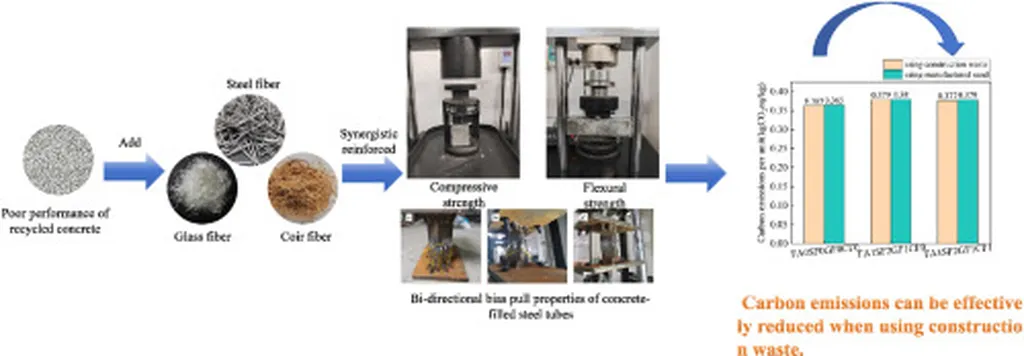
In a move that could reshape sustainable construction practices, researchers have unlocked a promising path forward for recycled concrete—one that balances strength, durability, and environmental responsibility. Led by Professor Bari J Abdul from the Department of Civil Engineering at K.S. Rangasamy College of Technology, a recent study published in the *E3S Web of Conferences* (translated from French as *Web of Conferences in Energy, Environment and Sustainability*) explores how blending recycled aggregate with hybrid fibres can produce concrete that rivals traditional mixes in performance while cutting reliance on virgin materials.
The challenge is clear: as urbanization accelerates, so does the demand for concrete—a material whose production is energy-intensive and environmentally taxing. Traditional concrete relies heavily on natural aggregates, whose extraction contributes to habitat loss, carbon emissions, and resource depletion. Enter recycled coarse aggregate (RCA), derived from demolished concrete. While RCA offers a sustainable alternative, its use has historically come at a cost to mechanical strength. That’s where fibre reinforcement comes in.
Professor Bari and his team systematically tested concrete mixes where natural coarse aggregate was replaced with RCA at levels ranging from 0% to 50%. To counteract the expected drop in strength, they introduced a hybrid mix of polypropylene and nylon fibres at varying dosages. The results were telling. As RCA content increased, compressive strength declined—until fibres were added. At 30% RCA replacement and a total fibre content of 1% (split evenly between polypropylene and nylon), the concrete not only met but exceeded M25 grade standards, achieving over 25 MPa in 28-day compressive strength.
“What we observed was remarkable,” said Professor Bari. “The hybrid fibres don’t just patch up the weaknesses—they actively improve tensile and flexural strength, making the material more resilient under stress.” The study also found that fibre-reinforced mixes showed lower water absorption and better resistance to acid attack, key indicators of long-term durability.
These findings carry significant implications, especially for industries where concrete is a backbone material—like energy infrastructure. Power plants, substations, and renewable energy facilities often require durable, long-lasting concrete for foundations, containment structures, and drainage systems. By enabling higher RCA content without sacrificing performance, this research could help reduce the carbon footprint of construction while supporting circular economy principles.
As the global push for sustainability intensifies, innovations like hybrid fibre-reinforced recycled aggregate concrete (HFRRAC) offer a rare win-win: technical viability meets environmental stewardship. While further field validation is needed, the study suggests that with the right mix design, recycled concrete can step out of the lab and into the mainstream—helping industries meet net-zero goals without compromising structural integrity.
Published in the *E3S Web of Conferences*, this work adds to a growing body of evidence that the future of construction may be built not just on what we extract, but on what we thoughtfully reuse.