
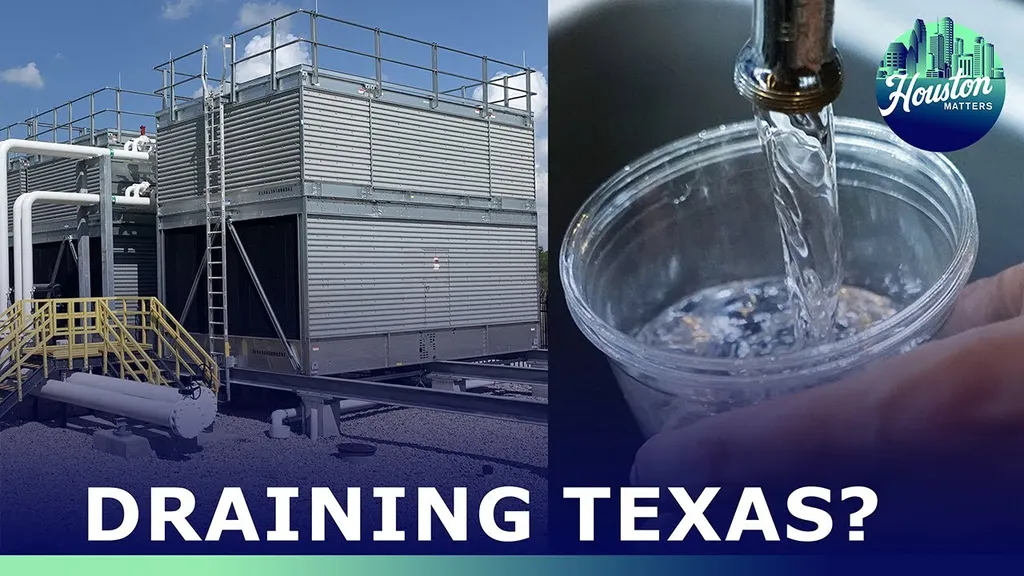
The tension between Texas’s booming data center industry and the state’s strained water resources is sharpening, exposing a paradox in how AI infrastructure consumes water. Data centers don’t just demand water for operations—they rely on it at every stage, from powering servers to manufacturing the microchips that run them. And as Texas lures more tech giants with promises of cheap energy and tax incentives, the water footprint of AI is becoming impossible to ignore.
Direct water use inside data centers is the most visible pressure point. Servers generate immense heat during high-performance computing, and the shift from air cooling to evaporative methods—though more energy-efficient—has amplified water loss. “In this evaporative cooling process, although less energy is used, significant water is lost as it evaporates with waste heat,” the Environmental Law Institute noted in its October 2025 report. “Essentially, optimizing for energy efficiency can actually worsen water efficiency.” Between 2014 and 2023, U.S. data centers increased their operational water use from 21.2 billion liters to 66 billion liters—a threefold jump that coincides with the rise of AI workloads. In Texas, where summer heat already strains municipal systems, this demand is colliding with drought conditions and competing uses in agriculture and municipalities.
But the water burden extends far beyond the facility fence line. The indirect footprint is staggering: U.S.-based data centers account for an estimated 800 billion liters of water annually through electricity generation and the production of servers, chips, and other components. The creation of a single microchip alone requires roughly 2.1 to 2.6 gallons of water to cool machinery and rinse contaminants during manufacturing. With semiconductor fabrication already water-intensive, locating data centers in water-scarce regions like West Texas—or building new ones there—risks deepening local shortages. The report highlights that over 160 new AI data centers have been built in U.S. regions with scarce water resources in the past three years, often during peak drought periods when utilities are already stretched.
Some tech giants are responding with pledges to balance their usage. Google and Microsoft have committed to returning more water to local ecosystems than they consume in manufacturing and cooling across their operations. Others are publishing sustainability reports with varying levels of transparency. Yet the absence of standardized reporting means comparisons are difficult, and local water authorities remain in the dark about cumulative impact. In Texas, where groundwater depletion and surface water rights are already contentious, this lack of coordinated oversight could turn a resource strain into a full-blown crisis.
The question now is whether the industry will self-regulate or face regulation from below. Texas municipalities are starting to push back. In Fort Worth, local officials recently denied a data center’s water permit due to insufficient drought contingency plans. Meanwhile, landowners in rural counties are raising concerns over groundwater drawdown from adjacent facilities. The tech sector’s growth narrative—built on speed, scale, and innovation—is clashing with the hard limits of hydrology.
If water becomes a bottleneck, it won’t just slow AI expansion—it could reshape where and how data centers are built. The industry may need to invest not only in more efficient cooling technologies but in water accounting that treats the resource as finite. Otherwise, the same infrastructure that powers the AI revolution could be its Achilles’ heel.